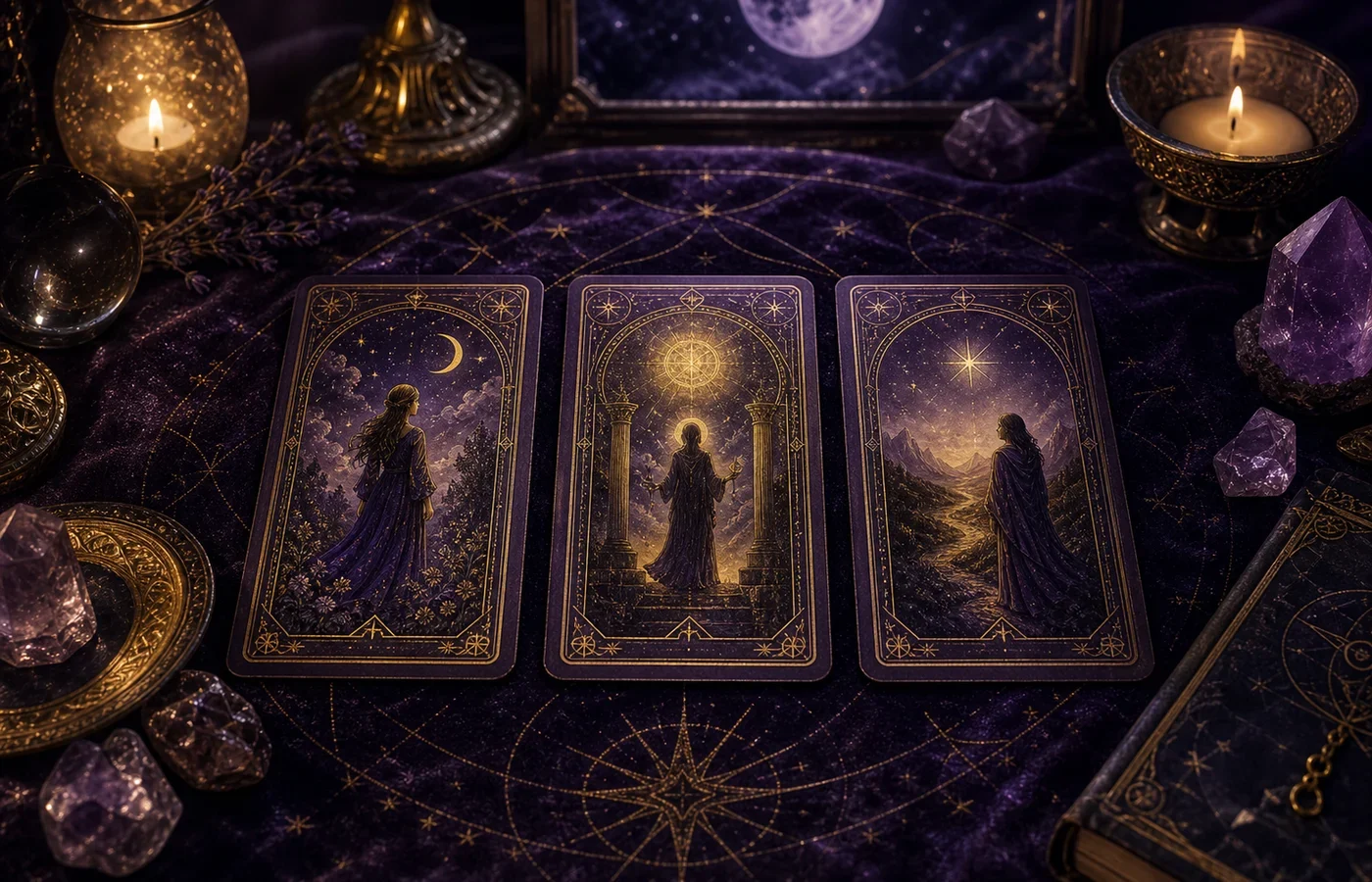
Three-Card Tarot Spread: Simple Method, Examples, and Interpretation
The three-card tarot spread is one of the most useful methods for beginners, but also one of the most powerful when used well. Three cards are enough to create a symbolic sentence: a situation, a tension, and a direction. The secret is not drawing many cards, but asking a clear question and reading the links between them.
Why three cards are enough
One card gives a symbol. Three cards create a dynamic. They show what came before, what blocks, what advises, or what is trying to emerge. The spread becomes a small scene: each card speaks, but their relationship tells the essential story.
- Card 1: context, root, or starting energy.
- Card 2: tension, obstacle, present, or sensitive point.
- Card 3: advice, direction, outcome, or next gesture.
- Meaning comes from positions as much as cards.
- Contrasts between arcana often reveal the key.
The simplest structures
The same method can serve many questions. Choose the structure before shuffling, otherwise the mind may adapt the meaning afterward. To begin, three models are enough: past-present-future, situation-obstacle-advice, body-heart-spirit.
- Past / present / future: useful for understanding an evolution.
- Situation / obstacle / advice: ideal for a decision.
- Me / the other / the bond: useful in relationships, without obsession.
- Body / heart / spirit: good for an inner state.
- Fear / truth / action: powerful when a question is blocked.
Interpretation example
Imagine a situation-obstacle-advice spread: Temperance, Eight of Swords, Queen of Wands. Temperance shows a need for soothing and adjustment. The Eight of Swords indicates mental fear or a feeling of being stuck. The Queen of Wands advises reclaiming presence, desire, and confidence without waiting for outside validation.
- Read each card in its position.
- Observe the progression: calm, mental block, return of fire.
- Notice the elements: water of Temperance, air of the Eight, fire of the Queen.
- Seek practical advice rather than a fixed prediction.
- Formulate one simple final sentence.
Mistakes to avoid
The three-card spread becomes confusing when the question is vague or when you keep drawing until the answer feels reassuring. Tarot is a symbolic mirror, not a tool for controlling another person or canceling uncertainty.
- Asking several questions at once.
- Redrawing until the desired card appears.
- Reading only keywords without looking at the image.
- Turning every difficult card into a bad omen.
- Forgetting to end with a concrete action.
With the Grimoire
In the Grimoire, tarot readings can be connected with your day, emotions, lunar phases, and astrological periods. With an active subscription, you can track repeating cards, compare readings with your inner state, and turn each reading into personalized guidance rather than an isolated interpretation.