Poimandres: the Corpus Hermeticum and the ascent beyond the seven
Poimandres is one of the foundational texts of Hermetic literature. It tells of a vision received by Hermes Trismegistus, a revelation about mind, light, human nature, and the return toward the divine. Its image of rising beyond the seven spheres has become a powerful language of inner transformation.
What is Poimandres?
Poimandres, also written Poimandres or Pimander in different translations, is the first tractate of the Corpus Hermeticum. The text presents itself as a revelation received by Hermes Trismegistus, the guiding figure of Hermetic wisdom. Hermes meets Poimandres, a presence described as sovereign Mind and shepherd of humankind. This is not simply another deity in a mythological pantheon, but a voice of knowledge leading the mind toward a wider perception.
The tract is not an operational magic manual. It is closer to a theological and cosmological vision: a human being receives an understanding of creation, human origins, and the possibility of a conscious return toward the divine. Manuscripts and translations have inspired different readings across centuries. We should therefore distinguish the ancient text, scholarly interpretations, and modern practices inspired by it.
The vision of light and Mind
At the beginning, Hermes enters an inner perception beyond ordinary experience. Poimandres shows him an immense light and an obscurity that seems to separate from it. The vision does not merely describe a physical beginning of the universe: it stages the movement from undifferentiated chaos toward a world ordered by Mind.
The Greek word Nous, often translated as Mind or Intellect, is not merely calculating intelligence. It suggests a faculty of direct knowing, able to perceive relationships between the human being, the cosmos, and the divine principle. In this view, rising does not mean leaving the body as a feat. It means learning to recognize what belongs to confusion, automation, and conscious light.
Primordial Human and the meeting with Nature
Poimandres then describes the manifestation of Primordial Human, associated with creative power and the ability to contemplate the order of the world. In a symbolic scene, Human sees a reflection in Nature and is drawn toward its beauty. The story presents the human condition as a double belonging: we are linked to a luminous origin, yet engaged with matter, emotions, instincts, and time.
This descent need not be read as a simple condemnation of body or Earth. It can be understood as a tension: we forget our origin when we identify completely with impulses, status, or fear of loss. Hermetic work is therefore less about despising the world than recovering a conscious presence within it.
The seven Rulers and the seven spheres
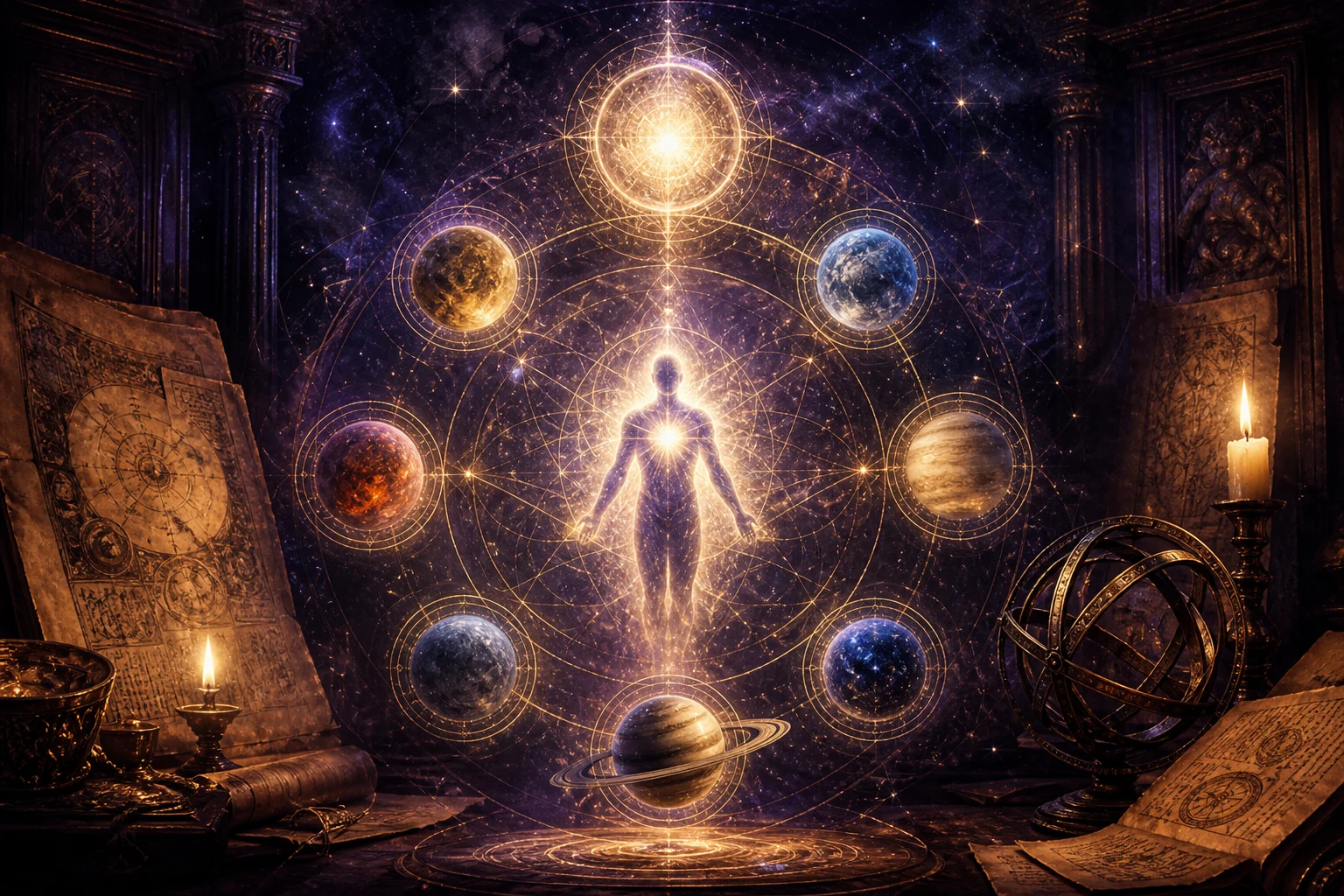
The tract speaks of seven powers or Rulers that organize the visible world and the action of fate. In later astrological and Hermetic readings, these levels are often connected with the seven traditional planets: Moon, Mercury, Venus, Sun, Mars, Jupiter, and Saturn. This correspondence is fruitful for meditation, but it should be presented as a symbolic framework inherited through Hermetic reception, not as a modern list stated identically in every translation of Poimandres.
The seven spheres can then represent forces shaping personality: emotional reflexes, the need to understand, desire, identity, assertion, expansion, boundaries, and time. They may be experienced as celestial influences, but also as psychological and existential layers. Ascent is not escape: it is a conscious passage through what governs us unconsciously.
What does it mean to go beyond the seven?
In the ascent scene, the text describes the gradual shedding of what belongs to the lower spheres. Elements return to their nature, character traits lose their grip, perceptions return to their sources, and the being moves toward a higher region. This movement is often summarized as going beyond the seven.
Beyond the seven appears the Ogdoad, the eighth reality or eighth sphere. It need not be understood as a geographical location in outer space. It can symbolize a level of harmony no longer subject to the mechanisms of fate in the same way. Hermes hears powers celebrating the source and receives a higher understanding of his path.
Some traditions and commentators extend the language toward a ninth or tenth reality. It is best not to confuse those developments with the exact detail of the first tractate. The central image remains clear: the seeker is not merely trying to obtain protection from cosmic forces, but to become lucid enough not to be entirely directed by them.
An ascent that begins with purification
In Poimandres, true knowledge is not separate from transformation. The text connects liberation with recognizing attachments, passions, and automatic reactions. Hermetic purification can therefore be understood as clarifying one's relationship with oneself: seeing fear without giving it total authority, recognizing desire without making it a law, and welcoming emotion without allowing it to decide alone.
This does not require rejecting emotion. Anger may signal a boundary, sadness a loss, longing a need, and fear a vulnerability. The Hermetic gesture moves these forces from immediate reaction toward awareness. Energy is not destroyed; it is returned to its proper place.
Poimandres and Hermes
Hermes Trismegistus is not only a hero who receives secrets. He is also a model of transmission. After his vision, he becomes one who speaks to others and invites them to seek knowledge. The text therefore links ascent with responsibility: understanding should not feed superiority, but a more truthful voice.
This matters for contemporary practice. Believing oneself more “awake” than others can become a new attachment. A mature spiritual practice is not measured by titles, claimed powers, or extraordinary promises. It is seen in a greater capacity to listen, acknowledge mistakes, and act without manipulation.
Historical rituals and what the text does not say
Poimandres is a revelation tract, not a book of detailed ritual procedures. It does not provide one protocol with objects, words, and gestures that everyone should reproduce. Later Hermetic practices developed prayers, hymns, planetary contemplations, consecrations, and symbolic ascent exercises, but they should not be presented as a ritual explicitly described by Poimandres itself.
This distinction protects both historical accuracy and spiritual freedom. We can receive the text as an inner map and create a personal practice inspired by its themes, provided we name it as a modern adaptation. A living tradition calls for study, humility, and respect for sources.
A contemporary ritual inspired by the ascent
The following is a modern meditative proposal, not an ancient reconstruction. It can accompany a reading of Poimandres, but it does not claim to reproduce a historical rite described in the tract.
Intention. Seek to see clearly what governs you so you can choose with greater awareness. Here, ascent is an inner movement: it requires no out-of-body experience, spectacular vision, or supernatural result.
Preparation. Have a notebook, a candle, and a quiet space. Sit comfortably, breathe slowly, and keep your feet in contact with the ground. Do not use substances or reduce your sleep in order to practise.
The seven passages. Take a few breaths for each stage. Do not try to erase the force you observe: recognize it, then give it a more appropriate place.
The passage beyond the seven. After the seven stages, remain silent for a few minutes. This eighth stage symbolically represents the Ogdoad: a space of integration that asks neither for a vision, a message, nor an immediate answer. Simply allow interpretations to settle.
The return. Open your eyes, drink some water, and write three sentences: what has become clearer, what remains open, and one concrete action you can take tomorrow. Extinguish the candle safely. Ascent is verified in the way we live, not in the intensity of an inner image.
Safety notes. Stop if the practice causes significant distress, disorientation, or a feeling of dissociation. Return to an ordinary grounding activity and seek support if needed. Spirituality does not require forcing an inner door.
- 1. Emotion — I feel without being entirely defined by what I feel.
- 2. Thought — I observe my stories before treating them as truths.
- 3. Desire — I recognize what attracts me without confusing want with necessity.
- 4. Identity — I can change without defending a fixed image of myself.
- 5. Will — I act with strength without seeking to dominate.
- 6. Expansion — I grow without taking all the space.
- 7. Boundary — I accept time, responsibility, and finitude.
A seven-day practice
You may revisit this ritual over seven days, one stage each evening, with journaling. Day one observes emotional reactions, day two repetitive thoughts, day three desires, day four self-image, day five control, day six the place given to abundance, and day seven the relationship with limits. On the eighth day, do not seek another challenge: give it to silence, gratitude, and return to ordinary life.
This rhythm provides structure without turning the spheres into fate. If an exercise creates significant distress, stop and return to ordinary grounding activities. Spirituality does not require forcing an inner door.
Beyond the seven: an ethical reading
Going beyond the seven does not mean becoming inaccessible or placing oneself above human laws. In an ethical reading, it marks the point at which we stop assigning responsibility to planets, wounds, or signs. Influences may illuminate context; they do not replace choice, repair, or discernment.
The most Hermetic question is therefore not “How can I control the seven spheres?” but “How can I recognize them without giving them my freedom?” The Ogdoad becomes an image of this quiet freedom: a center that does not deny the world, yet is not entirely scattered by it.
With the Grimoire
The Grimoire can become a journal of symbolic ascent. Relate the seven stages to your birth chart, transits, Moon phases, and tarot readings without turning these tools into verdicts. Record the difference between a felt influence, an interpretation, and an observable fact. The journal lets you revisit cycles and see which forces truly return.
The Rituals page can support preparation, the Planets page can offer symbolic language for the seven levels, and the Journal can preserve observations. With an active subscription, the Grimoire's personalization gives this exploration a more intimate framework while leaving each person responsible for their own path.
Closing
Poimandres offers a great image of knowledge: the human being remembers an origin, passes through the forces that shaped them, and discovers beyond the seven a quieter unity. This map is not a promise of power or an invitation to flee the body. It invites greater freedom of awareness, more responsible action, and a humbler relationship with mystery.