Indian spirituality: chakras, mantras, devotion and energy
Indian spirituality is a vast universe where energy, breath, sound, devotion and consciousness answer one another. It is not limited to the chakras or mantras popularized in the West: it invites you to connect body, heart, speech and intention through a living, gradual and respectful practice.
A path of breath, sound and consciousness
Indian spirituality crosses many traditions: Hinduism, yoga, tantra, bhakti, vedanta, popular practices, meditation, domestic worship and ascetic paths. Reducing it to one doctrine would be misleading. In a modern spiritual reading, its common thread is the search for union between inner energy and the wider order of life.
- Breath becomes a bridge between body and mind.
- Sacred sound guides attention.
- Ritual gives visible form to intention.
- Devotion opens the heart instead of merely controlling energy.
- The body is seen as a temple, not as an obstacle.
Prana: understanding vital energy
Prana is often described as vital breath, subtle circulation or animating force. Mystically, working with prana means sensing where energy flows, where it blocks and where it asks to be soothed. This can happen through breathing, chanting, meditation, symbolic gestures or deeper attention to sensations.
A simple practice is to breathe slowly while observing three areas: the lower belly for grounding, the heart for emotion, and the forehead for clarity. The aim is not to force a spectacular experience, but to listen to the natural movement of energy.
Chakras: seven doors of inner reading
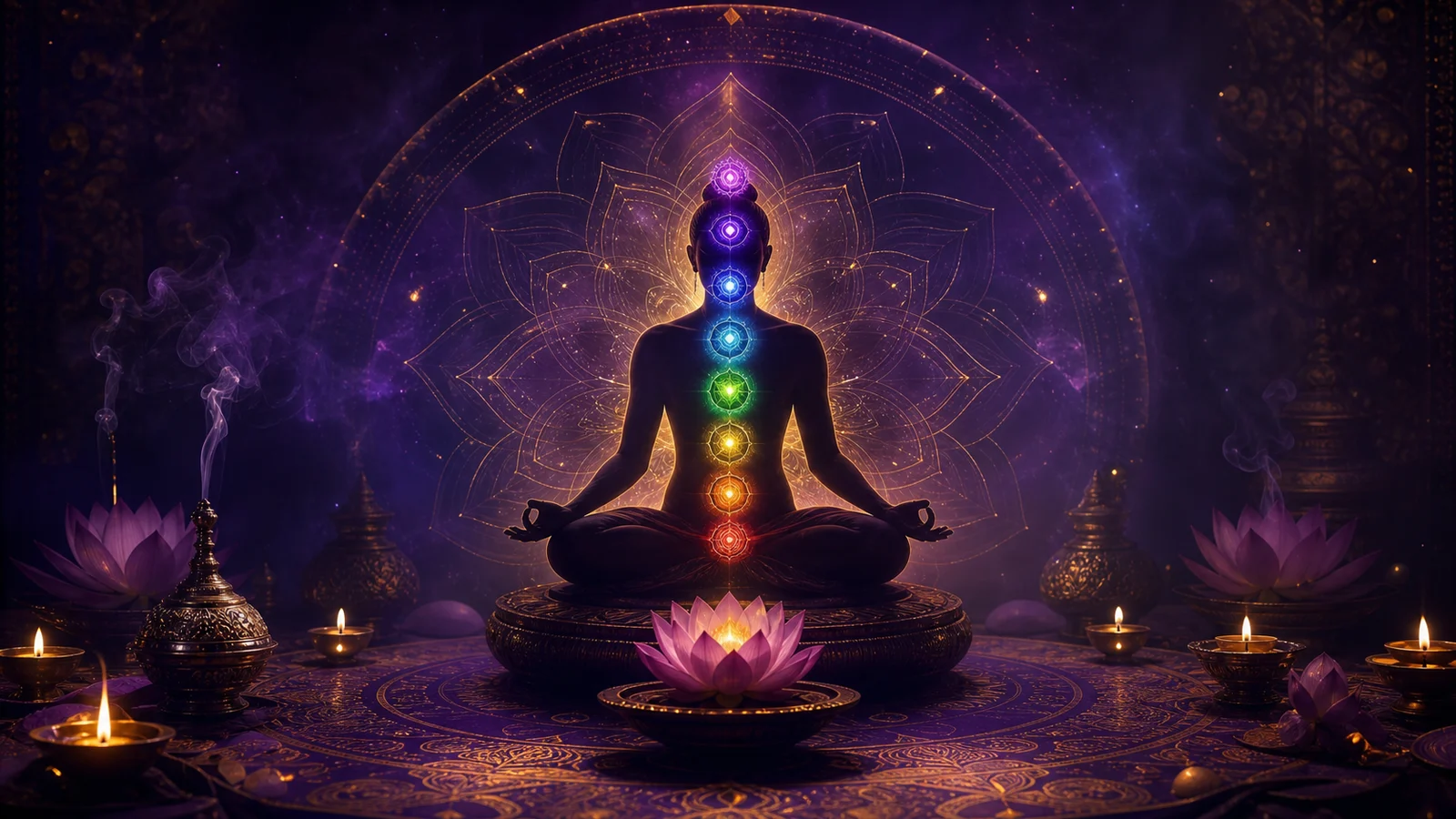
Chakras are often used as symbolic maps of the subtle body. Each center speaks to a family of experiences: safety, desire, will, love, speech, intuition and spiritual connection. They should not become a mechanical obsession, but they offer a useful language for understanding what you are moving through.
- Root: safety, body, territory, stability.
- Sacral: emotions, desire, creativity, flow.
- Solar plexus: will, confidence, personal power.
- Heart: love, forgiveness, bond, compassion.
- Throat: truth, speech, expression.
- Third eye: intuition, vision, discernment.
- Crown: faith, silence, connection to the greater whole.
Mantras: the magic of repeated sound
A mantra is not only a pleasant phrase: it is a vibration repeated with presence. Sound channels the mind, calms dispersion and engraves an intention into the body. A respectful practice avoids collecting mantras without context. It is better to choose one simple formula, repeat it consistently and observe what it changes.
If you use a traditional mantra, take time to understand its meaning and origin. If you prefer a personal formula, keep it short: “I return to my axis”, “My heart remains open”, “My speech becomes clear”.
Bhakti: the force of devotion
Bhakti, the path of devotion, reminds us that spirituality is not only energetic control or meditative performance. It opens a relationship: with a deity, a presence, an ideal, beauty or the heart itself. Singing, offering a flower, lighting a lamp, giving thanks or reciting a sacred name can make the soul more available.
In Monna Grimoire, this dimension matters: a ritual can be beautiful, intimate, emotional and sincere without needing to prove anything.
Deities, symbols and archetypes
Indian traditions hold an immense richness of divine figures. Shiva may speak of transformation, silence and the destruction of illusion. Shakti evokes creative energy. Lakshmi radiates abundance and harmonious beauty. Ganesh opens paths and helps cross obstacles. Sarasvati inspires speech, art, study and subtle intuition.
These figures deserve respect and nuance. A deity is not a simple “tool” to consume. You may approach it as a presence, archetype, spiritual mirror or symbolic force, but always with gratitude and cultural care.
A simple ritual inspired by this path
Prepare a clean space, a candle or lamp, a bowl of water, a clear stone and a journal. Breathe slowly seven times. Choose one energetic center to listen to, then write a short sentence: “Today I purify my speech”, “Today I strengthen my heart”, “Today I return to my breath”.
- Light the flame.
- Place one hand on the chosen chakra area.
- Repeat your phrase or mantra 9 times.
- Note the dominant sensation.
- Close with simple gratitude.
Common mistakes to avoid
The first mistake is mixing everything without respect: symbols, deities, mantras and deep practices are not interchangeable decorations. The second is forcing energy: chasing intensity can exhaust the emotional system. The third is forgetting the body: sleep, food, breathing and stability matter as much as ritual.
With the Grimoire
The Grimoire helps connect this path to your birth chart, emotional state, Moon and personalized rituals. If your period favors grounding, root chakra work may be more relevant. If the Moon activates emotion, the heart or sacral center may become a priority. If your journal shows mental dispersion, a short mantra can become your daily thread.
Yoga, tantra and bhakti: three very different doors
In Western imagination, yoga is often reduced to postures. In a broader spiritual reading, it is above all a path of union: uniting breath, attention, discipline, body and consciousness. Yoga can become a way to purify perception, stabilize energy and make the mind more available.
Tantra is also often misunderstood. It is not limited to sacred sexuality: it speaks of energy, transformation, presence in the body, ritual, mantra, visualization and integration of the world rather than escape from it. Bhakti opens yet another door: devotional love, song, offering and the heart.
- Yoga: inner discipline, breathing, presence, union.
- Tantra: energy, transformation, symbols, subtle body.
- Bhakti: love, chanting, offering, relationship with the divine.
- Vedanta: knowledge, consciousness, inquiry into the self.
- Domestic puja: simple ritual, lamp, flower, incense, gratitude.
Mantras and the power of the sacred name
A mantra works as a vibrational anchor. Its regular repetition creates an imprint in the mind and body. In many Indian traditions, the divine name is not merely information: it carries presence. Repeating a name, syllable or formula can therefore become a way of connecting with a spiritual quality: protection, clarity, love, strength or wisdom.
For modern practice, sobriety is best: choose one mantra, understand its meaning, avoid using it as decorative sound and observe what it truly changes in your inner state. Sound should become a path, not a collection.
Cultural respect and spiritual care
Indian spirituality is living, multiple and ancient. It deserves more than a quick assembly of symbols. Using a mantra, representing a deity or speaking about chakras asks us to recognize that these practices come from specific cultures, languages and lineages. Personal practice can be deep, but it gains power when it remains humble.
Avoid turning Ganesh, Shiva, Lakshmi or Kali into simple “energies to invoke” without context. Take time to read, compare sources, distinguish inspiration from appropriation and keep clear gratitude toward the traditions that transmit these tools.
Reading further without scattering yourself
Books can help you move beyond overly simplified content. Look for works on traditional yoga, bhakti, mantras, the Upanishads, Shiva/Shakti symbolism or the history of tantric practices. The goal is not to master everything, but to practice with more respect and depth.