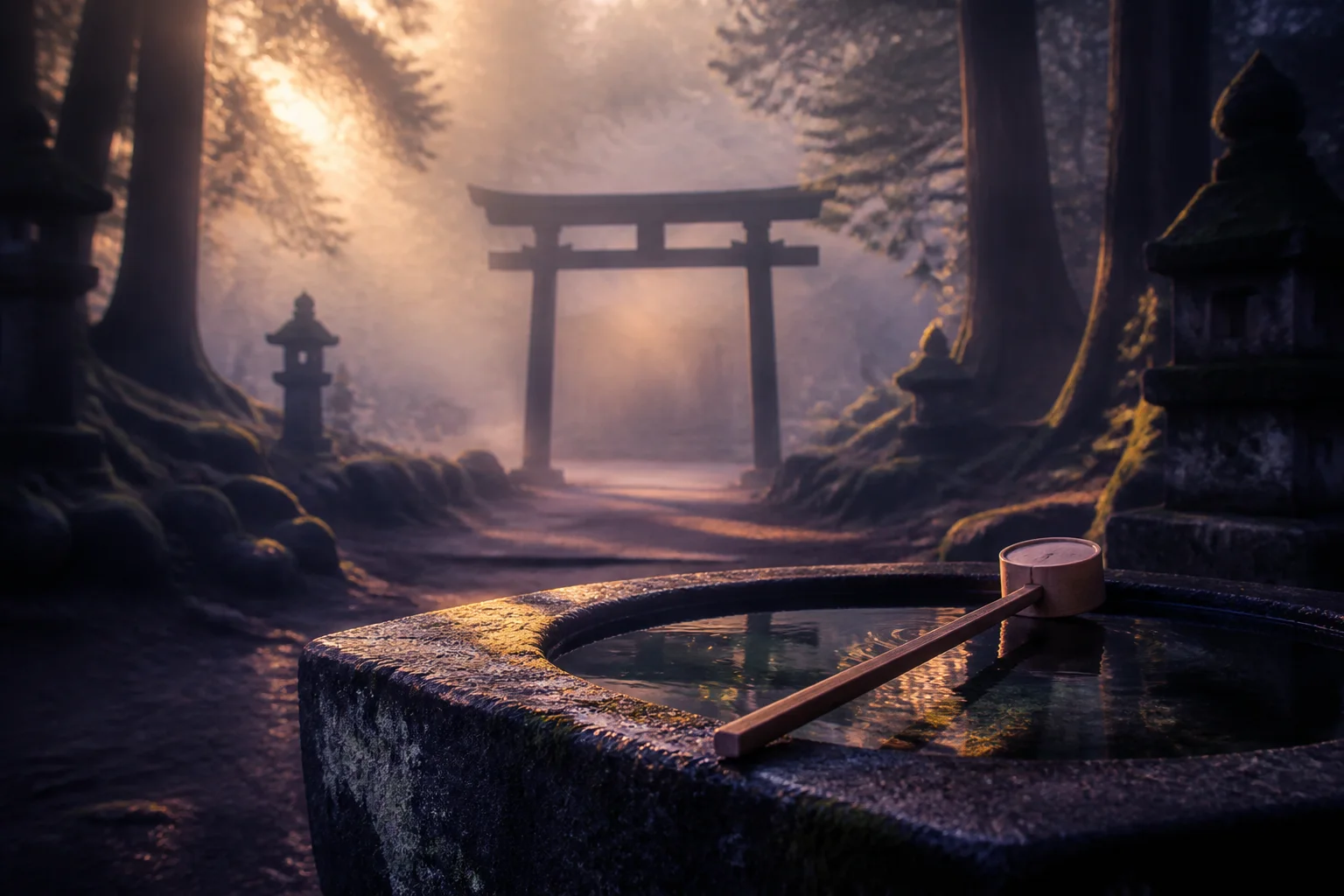
Shinto purification: inspiration, respect, and the symbolism of clarity
Shinto purification is more than a method for removing negative energy. It belongs to a relationship with kami, places, gestures, and inner clarity. This article offers cultural context and an open inspiration without reproducing restricted rites.
A tradition connected to kami and place
Shinto, or the way of the kami, developed in Japan through practices connected with shrines, seasons, ancestors, nature's forces, and community life. Kami cannot be perfectly translated as “god”: the word can refer to a presence, power, or sacred quality connected to a place, phenomenon, lineage, or revered figure.
Purification makes sense within this relationship. It prepares body and mind to enter a space of respect. It does not mean that nature or people are morally impure; it suggests a return to a clearer, more ordered, attentive disposition.
Harae and misogi: two distinct references
Harae refers to forms of purification. It may be performed by officiants and in ritual contexts, with gestures and words belonging to a specific tradition. Misogi is associated with purification through water, sometimes in a natural or ceremonial setting. These terms are not universal synonyms for “energy cleansing”.
For visitors from outside the tradition, the respectful approach is to study these ideas without claiming to perform an authentic Shinto rite. Personal inspiration may retain attention to gesture, entry, and gratitude, but it should be named as personal practice.
Water and the temizu gesture
At many shrines, visitors symbolically cleanse hands and mouth at a basin called a chozuya or temizuya. The gesture reminds us that a sacred threshold is not crossed in the same state of attention as an ordinary place. It creates a pause before prayer.
Water is not merely a magical object. It is a resource, a living element, and a responsibility. At home, this idea can inspire washing your hands consciously before journaling or beginning a personal ritual, without claiming to reproduce shrine temizu.
Torii, thresholds, and separated space
A torii often marks the entrance to a shrine-related space. It should not be reduced to Japanese decoration: it signals a change in attention. The threshold invites noise, haste, and unnecessary speech to remain behind.
At home, a symbolic threshold can be simple: opening a door after breathing, clearing a table, placing an unlit candle, or keeping a notebook for reflection. Its value comes from regularity and respect, not visual imitation.
Shimenawa, shide, and protected spaces
Shimenawa ropes and shide paper strips mark spaces or objects connected with the sacred. They belong to specific cultural and ritual contexts. Reproducing them as magical décor without understanding their purpose can empty the symbol of meaning.
For personal practice, choose a boundary that is not borrowed: a neutral ribbon, local stone, written sentence, or carefully cultivated plant. The aim is to state your intention, not appropriate a religious emblem.
Purification, kegare, and repair
The term kegare is often translated too quickly as “impurity”. It may relate to forms of pollution, death, illness, or events that disturb relational balance. A modern reading should never turn it into a judgment about a person's worth.
Purification can therefore inspire concrete repair: acknowledging hurtful words, cleaning a shared space, caring for water, respecting a place, or restoring a relationship. A spiritual gesture becomes deeper when it changes how we inhabit the world.
An open home inspiration, not a closed rite
Prepare a bowl of clear water, a towel, and a notebook. Before touching the water, name the place where you are and silently thank the resource. Wash your hands slowly, then write what you wish to clarify and one concrete repair you can begin.
Do not pour water into nature, add salt or perfume to a stream, or present this as a traditional ceremony. It is only inspired by attention to threshold, cleanliness, and gratitude.
Cultural respect and common mistakes
Do not blend kami, chakras, Reiki, shamanism, and “Japanese energy” as if they formed one doctrine. Shinto has its own history, institutions, shrines, and practices. Do not use prayers or sacred emblems without context, claim an officiant role, or sell an imitation as transmission.
Study, respectful shrine visits, serious books, and listening to people within the tradition are better than social-media shortcuts.
With the Grimoire
The Grimoire can support this inspiration through a purification journal, Moon tracking, personal rituals, and emotional cycles. With an active subscription, record your inner state before and after a clarifying gesture, then relate the change to transits and periods of transition. The aim is not to borrow a religious identity, but to cultivate more respectful presence.