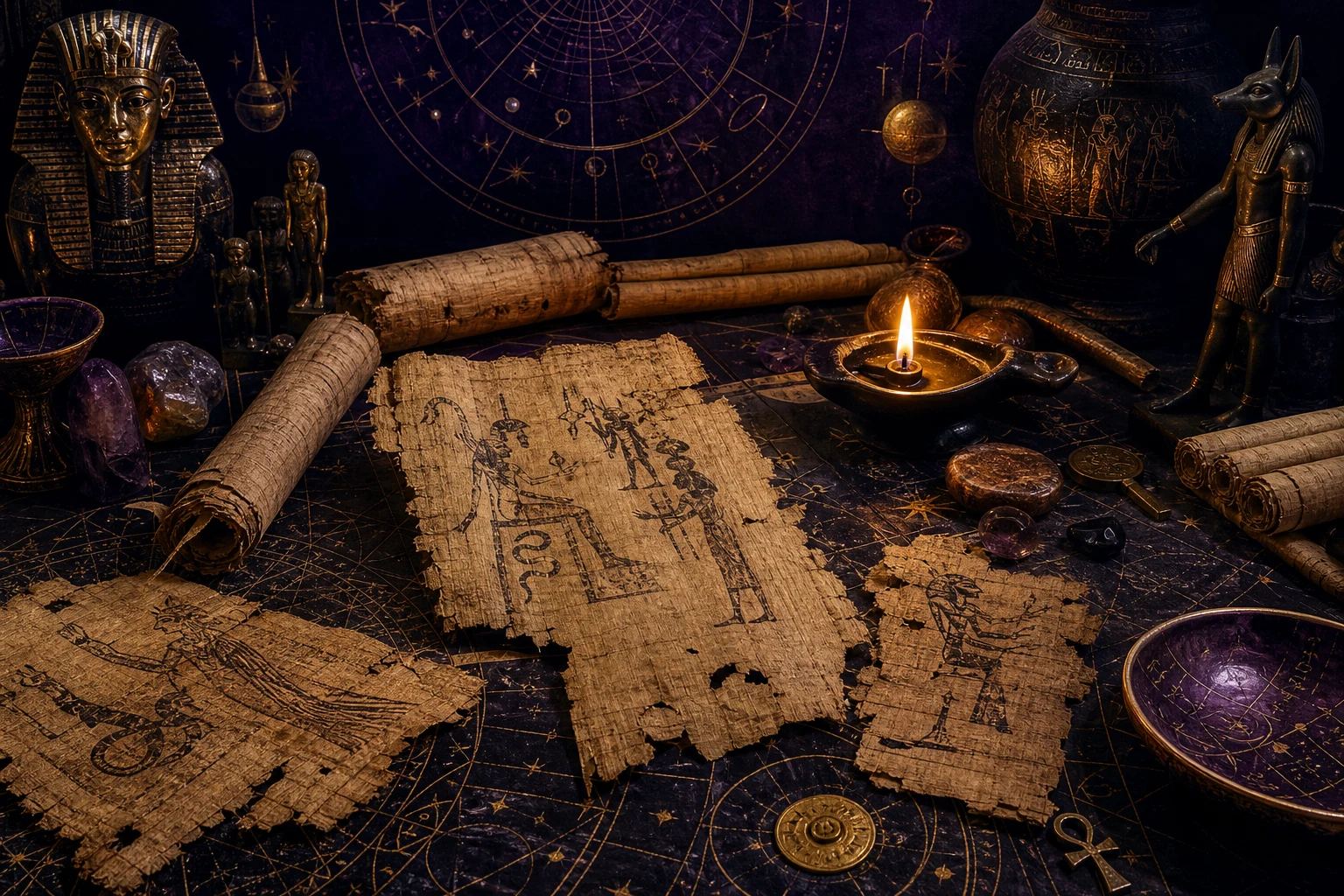
Papyri Graecae Magicae : histoire et grandes catégories de rituels
Les Papyri Graecae Magicae, souvent abrégés PGM, forment un ensemble de papyrus rituels provenant principalement de l'Égypte gréco-romaine. Ils ne sont pas un livre unique ni un système uniforme, mais une bibliothèque fragmentaire où se rencontrent prières, hymnes, recettes, amulettes, divination, astrologie et relations complexes avec les puissances divines.
Un corpus, pas un grimoire unique
L'expression Papyri Graecae Magicae signifie « papyrus magiques grecs ». Elle désigne un corpus édité et étudié par les chercheurs, notamment à partir de la collection publiée par Karl Preisendanz au XXe siècle. Les textes eux-mêmes sont plus anciens et proviennent de milieux variés de l'Égypte hellénistique, romaine et de l'Antiquité tardive.
Il est essentiel de ne pas imaginer un ouvrage intitulé simplement « le PGM ». Les papyrus sont des manuscrits distincts, souvent fragmentaires, qui peuvent rassembler plusieurs recettes dans un même rouleau. Certains ressemblent à des manuels de praticiens, d'autres à des textes appliqués pour une personne précise, une amulette ou une demande déterminée.
L'Égypte gréco-romaine, un carrefour spirituel
Les PGM sont principalement écrits en grec, mais le corpus conserve aussi des éléments démotiques, égyptiens, coptes, juifs, grecs et parfois des noms ou formules venus d'autres horizons. Cette coexistence n'est pas un mélange aléatoire au sens moderne : elle reflète une société où les langues, les temples, les cultes et les savoirs circulaient.
Les divinités grecques peuvent être rapprochées de formes égyptiennes, des noms bibliques peuvent apparaître auprès d'invocations helléniques, et des images astrologiques se mêler à des gestes rituels. Cette porosité est l'une des grandes richesses du corpus, mais elle interdit les affirmations trop simples du type « voici la vraie magie grecque » ou « voici un rituel purement égyptien ».
Comment les textes nous sont-ils parvenus ?
Le climat de l'Égypte a permis la conservation de nombreux papyrus, alors que d'autres traditions écrites ont disparu. La transmission reste pourtant incomplète : certains rouleaux sont abîmés, des passages manquent, les signes sont difficiles à lire et les titres ont parfois été ajoutés par les éditeurs modernes.
Les PGM ne représentent donc pas toute la spiritualité antique. Ils donnent accès à des pratiques privées, spécialisées ou marginales, mais ils ne doivent pas être utilisés seuls pour reconstruire une religion entière. La recherche contemporaine compare les papyrus aux inscriptions, aux objets, aux textes littéraires et aux archives de la vie quotidienne.
Les grandes catégories de pratiques
Les objectifs des textes sont très divers. Les catégories suivantes sont des repères modernes pour comprendre le corpus, pas une classification antique officielle.
Une même recette peut appartenir à plusieurs familles. Une demande de révélation peut utiliser une image planétaire, une prière et une fumigation ; une amulette peut être à la fois protectrice, thérapeutique et identitaire.
- Divination et révélation — obtenir une réponse, une vision, un rêve ou un signe à travers une relation rituelle avec une puissance divine.
- Protection et apotropaïque — écarter un danger, porter une amulette, protéger une maison, un voyage, une personne ou un moment de vulnérabilité.
- Guérison et apaisement — associer prières, paroles, plantes, gestes et objets dans une vision ancienne du soin, souvent impossible à séparer de la médecine et de la religion.
- Amour, attraction et séparation — rechercher une relation, une faveur ou une influence affective ; certains textes cherchent aussi à contraindre, ce qui pose aujourd'hui des questions éthiques majeures.
- Succès, faveur et réputation — demander une réussite, une place sociale, une victoire, une clientèle ou la bienveillance d'une personne importante.
- Contrainte, conflit et malédiction — agir contre un adversaire, retenir une action ou provoquer une rupture, catégorie qui rappelle que les PGM contiennent aussi des pratiques de domination.
- Astrologie et puissance planétaire — travailler avec les cycles célestes, les heures, les jours, les décans ou des images planétaires dans un cadre rituel.
- Théurgie et rencontre du divin — chercher une vision, une présence tutélaire, une révélation ou une union symbolique avec une puissance supérieure.
Divination, rêves et révélation
Les textes de révélation cherchent parfois à établir une relation avec une divinité, un daimôn ou une puissance intermédiaire. La finalité n'est pas toujours de prédire l'avenir : il peut s'agir de recevoir un conseil, une connaissance cachée, une réponse à une question ou une confirmation.
Les rêves occupent une place importante dans l'imaginaire rituel antique. Le sommeil devient un seuil, mais ce seuil est encadré par des préparations, des paroles, des images et des attentes. Il ne faut pas transformer cette littérature en preuve que chaque rêve est un message surnaturel ; elle montre surtout combien le rêve était considéré comme un espace possible de rencontre et d'interprétation.
Protection, amulettes et objets chargés
Les PGM témoignent d'une culture où un objet pouvait porter une inscription, un nom, une figure ou une prière destinée à protéger son porteur. La protection n'était pas seulement une idée abstraite : elle s'inscrivait dans un bijou, un morceau de papyrus, une gemme, une lamelle, un sceau ou un objet placé dans un lieu.
Le terme amulette recouvre des réalités différentes. Certaines pièces étaient préparées pour un usage particulier, avec le nom d'une personne ou une demande concrète. D'autres appartenaient à des traditions plus larges. Cette personnalisation explique pourquoi il serait réducteur de vendre aujourd'hui n'importe quel symbole comme une amulette antique authentique.
Guérison, plantes et limites historiques
Dans le monde antique, les frontières entre médecine, religion et pratiques magiques ne correspondent pas à nos catégories contemporaines. Un texte peut associer une invocation, une plante, un parfum, un geste et une demande de guérison. Cela ne signifie pas que toutes ces méthodes sont sûres ou efficaces selon les connaissances actuelles.
Les références aux soins doivent être lues historiquement. Elles ne remplacent pas un avis médical et ne justifient jamais l'ingestion d'une plante, l'abandon d'un traitement ou la fumigation d'une substance inconnue. Pour une inspiration moderne, gardez la dimension symbolique : écrire une intention de rétablissement, soutenir une personne, créer un espace calme et consulter un professionnel lorsque la santé est concernée.
Amour, influence et question du consentement
Les textes amoureux des PGM sont particulièrement révélateurs d'une tension entre désir, vulnérabilité et pouvoir. Certains cherchent une rencontre ou une faveur ; d'autres tentent d'attacher, de retenir ou de contraindre une personne nommée. Le fait qu'une pratique soit attestée dans un papyrus ne la rend pas souhaitable aujourd'hui.
Une lecture spirituelle responsable doit poser une limite claire : aucun rituel ne devrait viser à enlever à quelqu'un sa liberté ou son consentement. Un travail contemporain peut porter sur la disponibilité affective, la guérison d'une rupture, l'expression d'une demande ou l'ouverture à une relation réciproque, sans cibler une personne pour la forcer.
Astrologie, planètes et temps rituel
Les PGM montrent combien les cycles célestes pouvaient organiser le moment d'une pratique. Les jours, les heures, les signes, les décans et les puissances planétaires forment un langage de correspondances. Il ne s'agit pas encore de l'astrologie moderne telle qu'elle est pratiquée aujourd'hui, mais d'un ensemble de conceptions anciennes où le ciel, le destin et le rituel se répondent.
Cette dimension dialogue naturellement avec la page Planètes et la page Lune du Grimoire. Elle peut servir à observer un moment, à formuler une intention et à tenir un journal des répétitions. Elle ne doit pas devenir un système fataliste où chaque configuration impose une action ou un résultat.
Les noms sacrés et les voix rituelles
Les textes emploient parfois des noms divins, des suites de syllabes, des mots étrangers, des vocalisations et des formules difficiles à traduire. Les chercheurs parlent souvent de voces magicae pour désigner une partie de ces expressions. Leur fonction pouvait être liée à l'autorité, au secret, à la sonorité, à la mémoire ou à la construction d'une présence rituelle.
Une voix rituelle n'est pas toujours une phrase à comprendre mot à mot. Son rythme, sa répétition et son étrangeté peuvent produire une atmosphère particulière. Mais recopier une formule hors de son contexte ne garantit rien et peut déformer une tradition. Dans une pratique personnelle, une phrase claire dans sa propre langue peut être plus honnête qu'une suite de syllabes présentée comme ancienne sans traduction fiable.
Théurgie, vision et relation au divin
Une partie du corpus cherche moins à obtenir un objet qu'à rencontrer une puissance. La personne qui pratique se prépare, purifie son espace, récite, prie, attend et interprète. La frontière entre magie, prière, mystère et théologie devient alors difficile à tracer.
Cette recherche de présence est l'un des aspects les plus fascinants du corpus. Elle demande cependant de distinguer expérience intérieure et preuve extérieure. Une vision peut être profondément transformatrice sans autoriser quelqu'un à se proclamer choisi, supérieur ou détenteur d'un pouvoir sur les autres.
Ce que les PGM nous apprennent sur le rituel
Les papyrus montrent qu'un rituel est souvent une architecture complète : une intention, un moment, un espace, une parole, un objet, une relation à une puissance, puis une manière de conclure. Le résultat recherché n'est qu'une partie de l'expérience. La préparation et l'interprétation donnent au geste sa cohérence.
Ils montrent aussi que les praticiens anciens n'étaient pas toujours enfermés dans un système pur. Ils empruntaient, adaptaient, traduisaient et combinaient. Cette créativité ne donne pas le droit d'effacer les cultures d'origine ; elle invite plutôt à étudier les transmissions et à reconnaître ce qui reste incertain.
Une approche contemporaine respectueuse
Il est possible d'étudier les PGM sans reproduire leurs opérations. Choisissez un extrait traduit par un spécialiste, notez la date et le contexte, puis observez les catégories de gestes : prière, purification, offrande, image, parole, attente et retour. Vous pouvez ensuite créer un rituel personnel non intrusif avec une bougie, un carnet et une intention de clarté.
Ne sacrifiez pas d'animal, n'ingérez pas de substance inconnue, ne tentez pas de contraindre une personne et ne laissez pas de feu ou d'objet dans un lieu naturel. Les pratiques de domination, les promesses de guérison et les recettes trouvées sans contexte ne doivent pas être transformées en conseils pratiques.
Avec le Grimoire
Le Journal peut servir à noter les rêves, les signes et les effets émotionnels d'une intention, sans confondre observation et preuve surnaturelle. La page Lune aide à suivre le temps symbolique ; la page Planètes offre un vocabulaire pour les correspondances ; le Tarot peut ouvrir une lecture réflexive ; les Rituels permettent de construire une pratique douce et personnelle.
Avec un abonnement actif, le thème natal et les transits peuvent enrichir cette lecture historique en donnant un cadre intime à la réflexion. Le Grimoire ne remplace pas les sources anciennes : il aide à les laisser dialoguer avec votre expérience actuelle.
Pour conclure
Les Papyri Graecae Magicae ne sont ni un livre de recettes homogène ni une preuve qu'une méthode ancienne fonctionne automatiquement aujourd'hui. Ils sont une archive fascinante des manières dont des personnes de l'Égypte gréco-romaine ont cherché la protection, la connaissance, l'amour, la santé, la faveur et la rencontre du divin.
Les étudier globalement permet de voir une magie faite de langues, de gestes, de matières, de prières et de relations. Les futurs articles pourront ensuite explorer certains papyrus, certaines divinités, les rêves, les amulettes ou les pratiques planétaires avec la précision nécessaire.