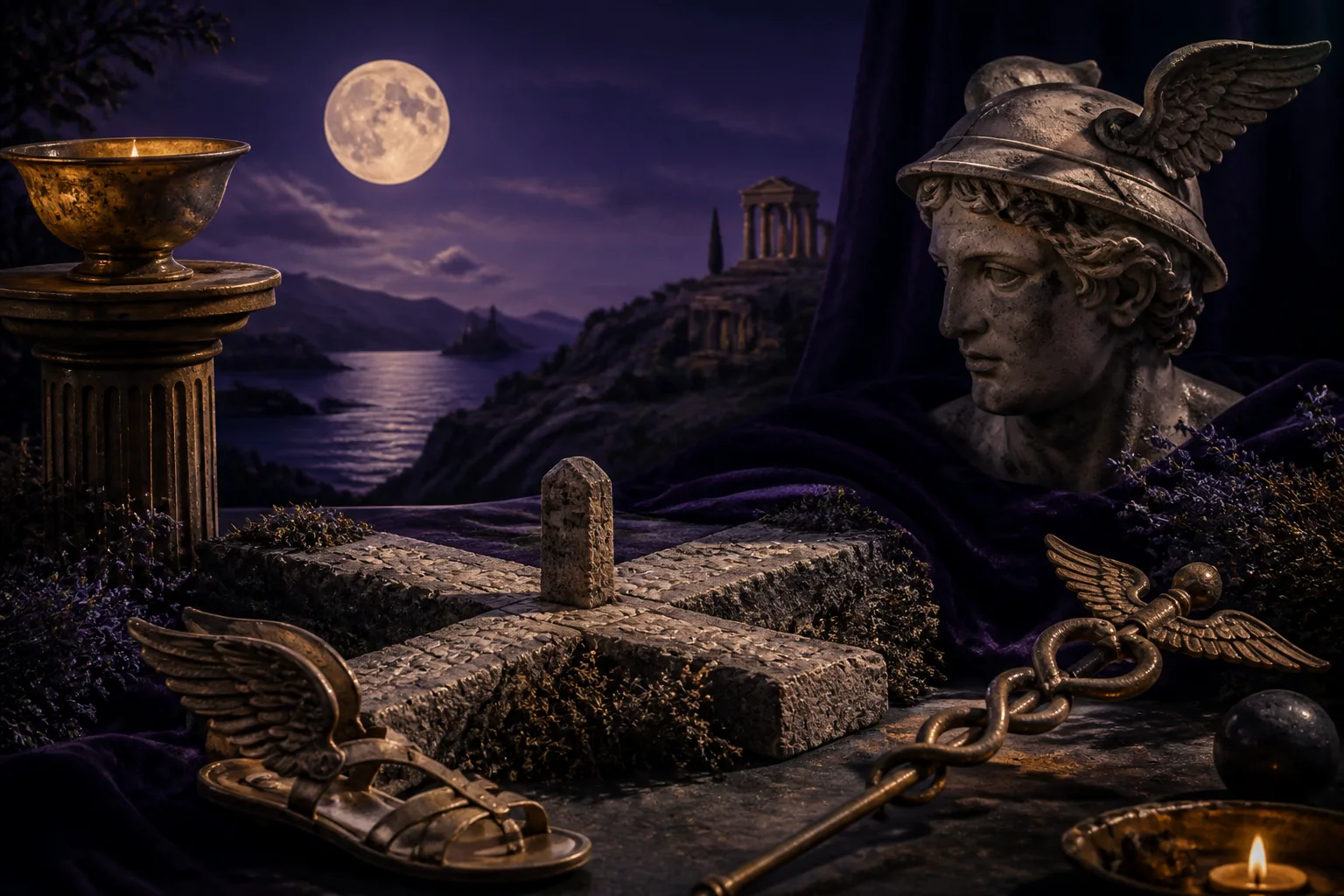
Hermes: the Greek god of messages, thresholds, and paths
Hermes is a deity of movement and transition. Messenger of the gods, guide of travellers, and guardian of symbolic crossroads, he accompanies moments when information must move, a decision needs flexibility, or an old path is no longer enough.
A deity between several worlds
In Greek mythology, Hermes belongs to the Olympians while remaining difficult to reduce to one function. He moves between gods and humans, speech and action, the visible world and the thresholds of the unseen. His energy is not stillness: it is movement, exchange, adaptability, and the ability to find an opening.
Hermes is associated with travellers, messengers, merchants, speakers, thieves, and people who read a situation quickly. This range shows that the same intelligence can serve transmission, negotiation, cunning, or transgression. The symbol therefore asks for discernment as much as speed.
Foundational myths
Ancient stories present Hermes as an inventive young god who already knows how to cross limits. In the story of his birth, he leaves his cradle, creates the lyre from a tortoise shell, and steals Apollo's cattle. Beyond the wonder of the story, the scene shows an intelligence that transforms what it finds and then negotiates the consequences.
Hermes also serves as Zeus's messenger and guides souls toward the Underworld as Hermes psychopompos. He is not death itself: he is the guide of transition, the one who understands that every passage needs direction, language, and presence.
Symbols of Hermes
The caduceus, winged sandals, petasos, road, threshold, tortoise, and rooster belong to his symbolic world. The caduceus is often confused with other modern emblems; in a Hermetic context, it mainly evokes mediation and circulation. Wings speak of speed and free thought. The tortoise reminds us that invention can arise from a simple object and that slowness can hold a deep music.
The threshold is his most intimate symbol. It marks a boundary between two states: before and after, silence and speech, hesitation and decision. Working with Hermes can mean learning to cross consciously instead of remaining trapped between states.
Hermes, speech, and truth
Hermes does not represent naive speech. Words can illuminate, persuade, divert, or manipulate. His archetype invites us to watch what we transmit: is the information accurate, useful, respectful, and offered at the right time? Intuition does not need to become dramatic to be heard.
For a spiritual practice, dedicate one journal page to messages received during the day: a repeated sentence, sudden idea, dream, meeting, or coincidence. First record the facts, then your interpretation. This separation protects clarity and prevents every detail from becoming an omen.
Hermes and inner crossroads
A crossroads does not always demand an immediate choice. It can invite you to recognize the available directions, existing resources, and cost of each path. Hermetic energy is useful when you need to send a message, change method, negotiate a boundary, or leave a rigid thought pattern.
Ask three questions: what information am I truly missing? Which path remains open if I release urgency? What words would make the situation fairer? These questions turn the symbol into inner practice.
A simple respectful practice
Place a notebook, a small key, or a coin as a symbolic reminder. Write one question about a current transition without asking to control another person. Breathe for a few minutes, then write three messages: what you know, what you assume, and what you can verify. End with an act of circulation: send an honest message, organize a document, book an appointment, or open a new lead.
This is not a reconstruction of an ancient rite. It is a contemporary exercise inspired by Hermes's themes: movement, discernment, transmission, and thresholds.
Symbolic offerings and boundaries
In some modern practices, people associate Hermes with roads, bread, honey, fruit, oil, or coins. An offering can remain simple, clean, and non-intrusive: gratitude, an act of repair, an attentive walk, or a donation connected to access to knowledge.
Do not present personal practice as a universal rule. Do not leave objects in nature, burn anything without safety, or promise that a sign will produce a specific answer. Respect begins with simplicity.
The shadow of the archetype
Hermes can become dispersion, lying, impatience, or constant escape. Looking for the next sign can prevent you from hearing the one already present. Intelligence can also become a way to avoid feeling or responsibility.
When working with this archetype, ask whether your movement comes from genuine openness or an inability to stay present. The right kind of cunning restores freedom without destroying trust.
With the Grimoire
In the Grimoire, record dreams of roads, messages, doors, and crossroads, then compare them with your Moon, transits, and emotional journal. With an active subscription, these observations can be connected to your birth chart and periods of change. Hermes becomes a thread for understanding when to speak, verify, negotiate, travel, or wait for the path to become clearer.