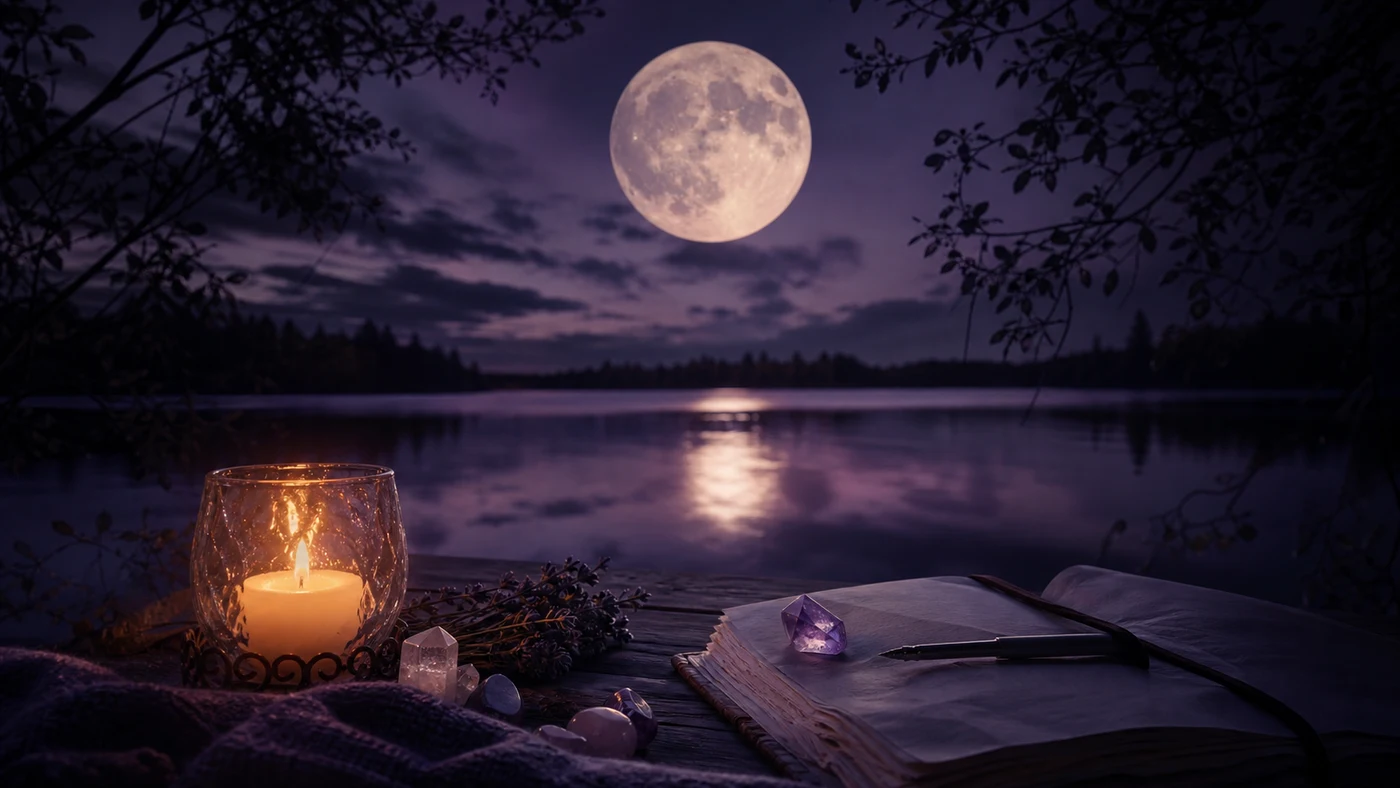
Lunar cycle and mood: observing patterns without getting lost
The Moon accompanies rhythms, inner tides and moments when emotion becomes more visible. Observing the lunar cycle does not mean blaming the Moon for everything we feel. It is a gentle way to notice patterns, listen to energy and give intuition a frame.
Why observe the Moon and your mood?
In astrology and spiritual traditions, the Moon symbolizes needs, memory, inner safety and emotional movement. Its phases offer an image-based calendar: the new Moon opens, waxing builds, the full Moon reveals and waning releases.
This language is not a mechanical rule. It becomes useful when you compare several cycles instead of drawing a conclusion from one restless evening.
The four main moments of the cycle
The new Moon invites silence, intention and a fresh start. The first quarter asks for a choice and an action. The full Moon amplifies visibility, emotions and realizations. The last quarter supports sorting, closure and rest.
Between these points, intermediate phases show how an intention evolves. You may feel more expansive at some moments and more inward at others, without this defining your whole personality.
Mood, energy and intuition
A changing mood can be connected to sleep, stress, relationships, the body, seasons and many personal factors. The Moon can become a symbolic mirror of these changes. It lets you ask: what is rising, what is growing, what needs to be released?
Intuition is easier to recognize when tracked over time. Note a sensation, dream or idea, then check a few days later what still feels true. The lunar cycle becomes a support for discernment rather than an automatic explanation.
Keeping a simple lunar journal
Each evening, note the Moon phase, energy level, dominant mood, one emotion, a dream if any and an intention. Use simple words: open, heavy, clear, scattered, sensitive, creative, quiet.
After one complete cycle, read your pages again. Look for patterns, not isolated coincidences. Perhaps the full Moon makes you creative, the last quarter supports tidying or one phase accompanies your clearest dreams.
The Moon through the zodiac
The phase is only one layer. The Moon's sign colors the atmosphere: a Water Moon may emphasize sensitivity, an Earth Moon stability, an Air Moon thought and exchange, and a Fire Moon momentum and assertion.
Your birth chart adds another layer: natal Moon, houses and transits can explain why the same phase is not lived in the same way by everyone.
A cycle-long observation ritual
Choose one intention for the next four weeks. At each phase change, light a candle and write what opened, what grew, what was revealed and what you are ready to release. A gentle stone, a glass of water or a journal page can simply mark the moment.
Do not try to force manifestation. The ritual makes inner movement visible; it does not control events.
With the Grimoire
The Grimoire brings together lunar phases, transits, emotional tracking, journaling and rituals. With an active subscription, you can compare feelings with your birth chart and notice periods that support intuition, grounding, creativity or release. This personalized reading turns the lunar calendar into a genuine self-observation tool.