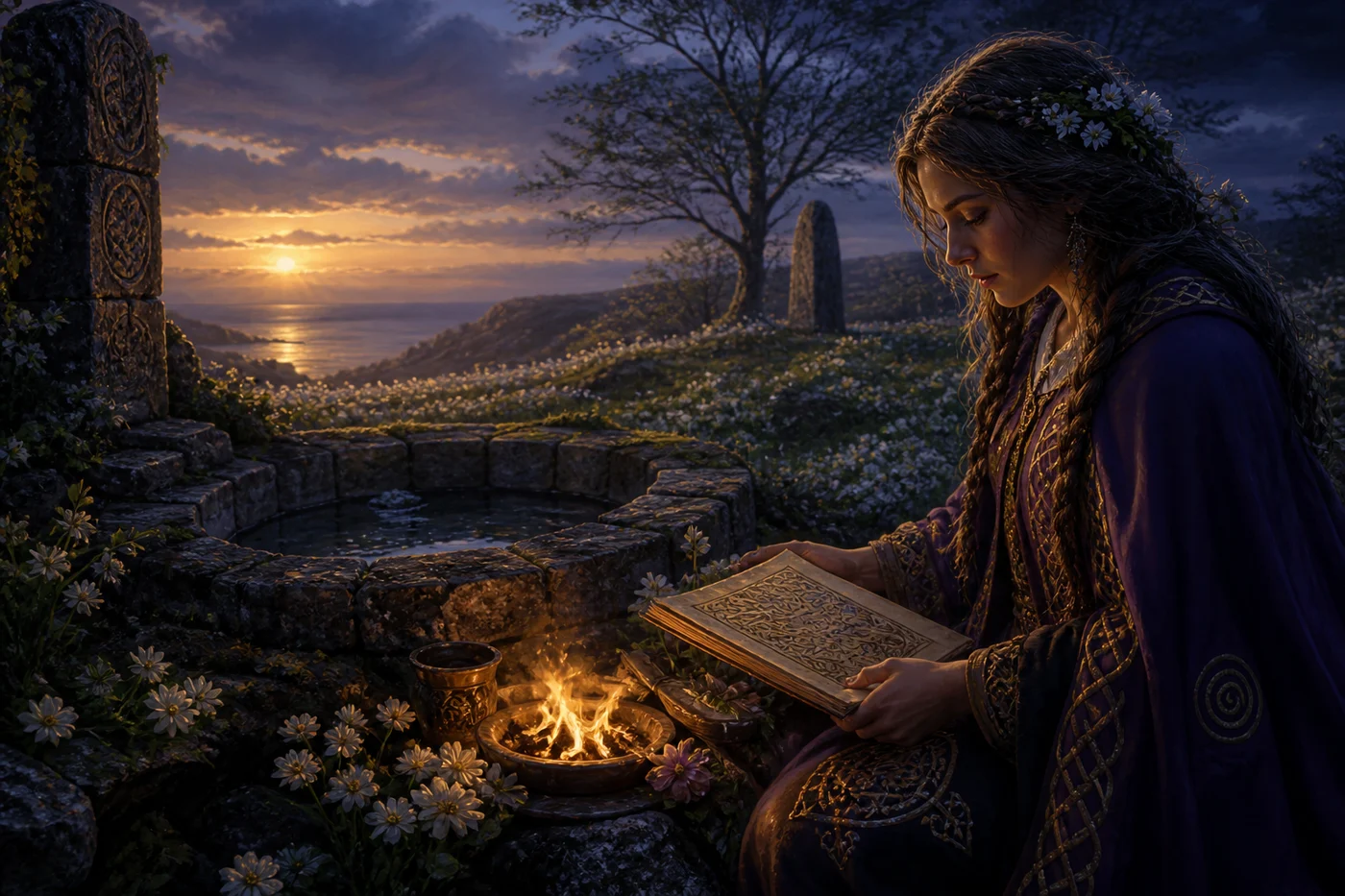
Brigid: fire, poetry, sacred water and Celtic renewal
Brigid is an Irish figure associated with fire, poetry, craft and springs. Her story sits at the meeting point of pre-Christian traditions and the cult of Saint Brigid, a complex continuity that deserves more than a simple shortcut.
A figure between goddess and saint
Brigid, Brigit or Bríg is an Irish figure whose contours change across texts and periods. Medieval stories, folk traditions and the life of Saint Brigid of Kildare echo one another, but they do not always prove a simple direct continuity.
This caution does not reduce the subject's richness. It reminds us that traditions are living, transmitted, reinterpreted and sometimes reconstructed from fragmentary sources.
Fire and inspiration
The fire associated with Brigid can be understood as warmth, inspiration, care and transformation. It is more than a household flame: in Irish imagination, fire protects the home and gives shape to materials, words and ideas.
In personal practice, this symbolism can support writing, drawing, cooking or a project you want to nurture. It is better to speak of inspiration from Brigid than to claim to reproduce an ancient rite.
Poetry and truthful speech
Brigid is often connected with poetry and speech. This association invites us to see creativity as a bridge between inner life and the world. A poem, prayer, song or sentence can become a place where emotion changes form.
Truthful speech is not perfect speech. It asks us to choose words, avoid promises we cannot keep and leave room for silence.
Springs and healing
Many springs and wells connected with Saint Brigid exist in Ireland. Some are part of folk traditions, visits or votive gestures. Their meaning depends on the place and its community; not every spring carries the same story.
Water can symbolize cleansing, movement and care. It should never be presented as medical treatment. Follow local rules, do not pollute the water and do not take objects left by visitors.
Imbolc and returning light
Brigid is often linked with Imbolc, a seasonal festival placed near the beginning of February in traditional calendars. Contemporary practices vary widely. Many people see it as a threshold between winter and the first promise of spring.
A simple gesture is to clean a space, light a candle and write what you want to grow slowly. This open practice draws on a seasonal cycle without claiming to be a traditional ceremony.
Home and craft
The hearth represents continuity: it warms, gathers and requires care. Brigid can therefore be connected with crafts, hands, making and transmission. Spirituality is not only an inner experience; it also lives in what we tend each day.
Choose one skill you want to resume, learn or pass on. A regular gesture is stronger than a spectacular intention forgotten the next day.
A respectful modern practice
Place a candle, a bowl of water and a notebook in a safe space. Write one quality to grow, one word to repair and one creative action for the week. Extinguish the flame safely and return the water respectfully.
This is a personal reflection practice. It is not a substitute for Irish devotion, community rites or initiatory traditions.
With the Grimoire
Brigid naturally connects with the waxing Moon, renewal rituals, creative journaling and pages where you track projects. With an active subscription, the Grimoire can combine your chart, emotional cycles and transits to choose a supportive time for creation or renewing a commitment.
What to avoid
Do not mix Brigid, modern Druids, saints, witches and every Celtic tradition into one system without context. Do not present modern practice as certain reconstruction. Context, sources and respect for places remain essential.