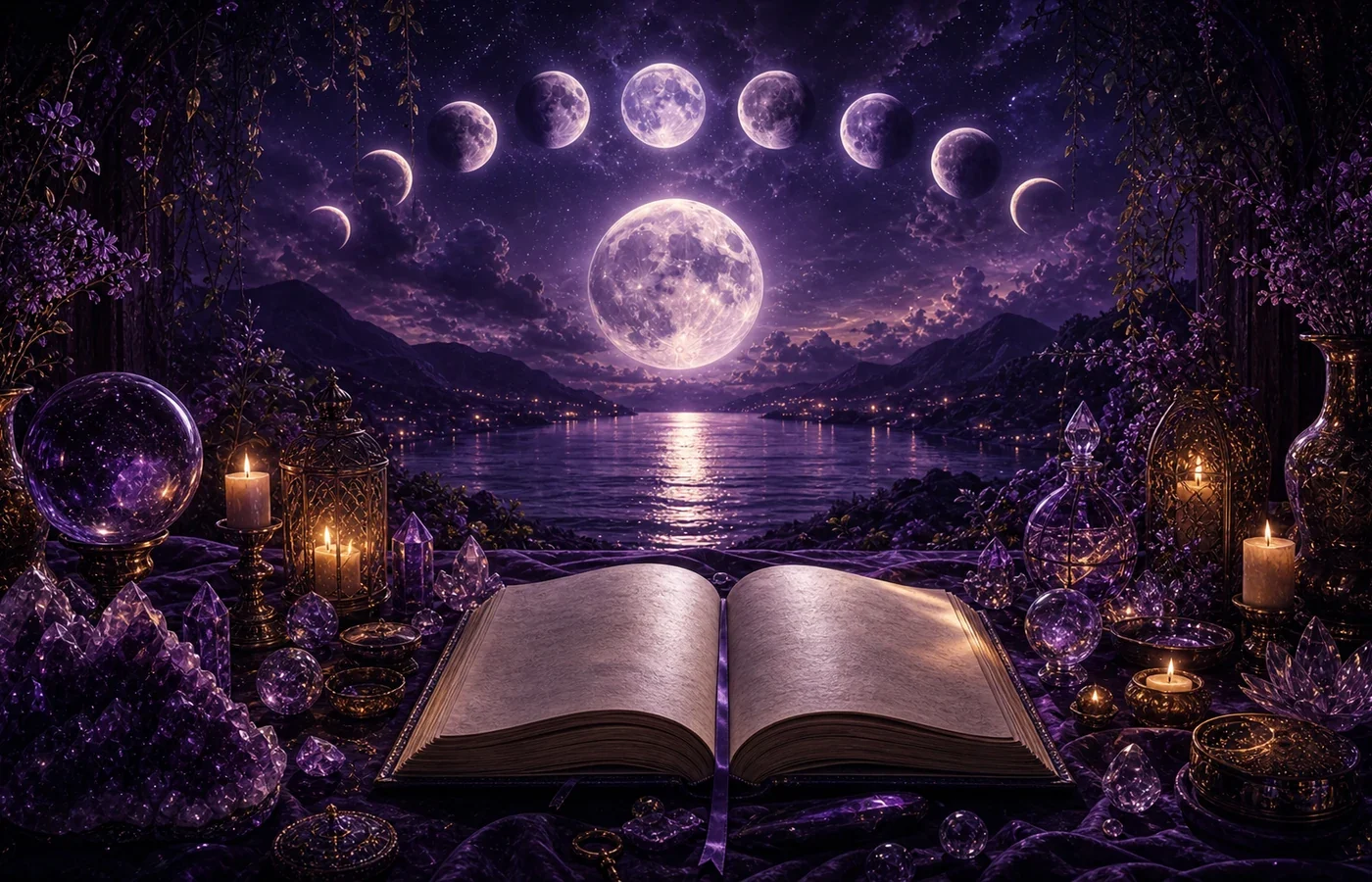
The Moon: Spiritual Meaning, Lunar Phases, and Influence on Personal Cycles
The Moon is one of the most accessible markers for following inner cycles. It visibly changes phase, rhythms the nights, and has long symbolized emotions, intuition, rest, memory, and the need for safety. In astrology, it does not only describe an atmosphere: it speaks about what nourishes or fragilizes you.
What the Moon represents
Symbolically, the Moon speaks about the inner world: emotions, needs, habits, sleep, memory, attachment, and receptivity. It shows what soothes, reassures, and reactivates. In a birth chart, the Moon is often essential for understanding spontaneous reactions.
- Emotions: what rises before conscious reflection.
- Safety: what helps you feel protected and stable.
- Habits: routines, reflexes, family memory.
- Intuition: sensitive perception, feelings, subtle signals.
- Body: need for rest, rhythm, and recovery.
Lunar phases in clear terms
Each phase can be used as a practical marker. It is not a magical rule, but a symbolic calendar useful for observing, beginning, adjusting, culminating, then releasing.
- New moon: intention, silence, preparation, new cycle.
- Waxing crescent: first gestures, renewed momentum, trust.
- First quarter: decision, friction, action.
- Gibbous moon: adjustment, improvement, patience.
- Full moon: clarity, culmination, revelation, release.
- Last quarter: sorting, review, cleansing, simplification.
Why follow the Moon in a journal
A lunar journal lets you verify what you truly experience instead of applying ready-made meanings. Note the phase, energy, mood, sleep, tensions, and important events. After a few cycles, patterns appear.
- Identify phases when you are more productive.
- Observe fatigue or hypersensitivity moments.
- Connect emotions, sleep, and decisions.
- Prepare rituals with more precision.
- Distinguish your real cycles from general ideas.
New moon and full moon: the difference
The new moon is more inward: it invites intention, less noise, and cycle preparation. The full moon is more visible: it reveals what has matured, what overflows, or what must be named. Both are complementary.
- New moon: begin more discreetly.
- Full moon: see what has reached maturity.
- New moon: choose a direction.
- Full moon: release what takes too much space.
- Between the two: adjust through small gestures.
Simple lunar rituals
An effective lunar ritual stays simple. A clear question, a notebook, and a few minutes are enough. Avoid multiplying crystals, candles, cards, and requests if it scatters you. The ritual should bring you back to a useful decision or observation.
- New moon: write a realistic intention for the cycle.
- Full moon: write what needs recognition or release.
- Last quarter: sort a space, thought, or habit.
- Before sleeping: note three feelings without judgment.
- With tarot: draw one card to clarify the phase.
With the Grimoire
The Grimoire connects the lunar phase to the birth chart, journal, transits, and rituals. This moves you from a general Moon reading to tracked reading: your energy, needs, repetitions, and favorable periods.