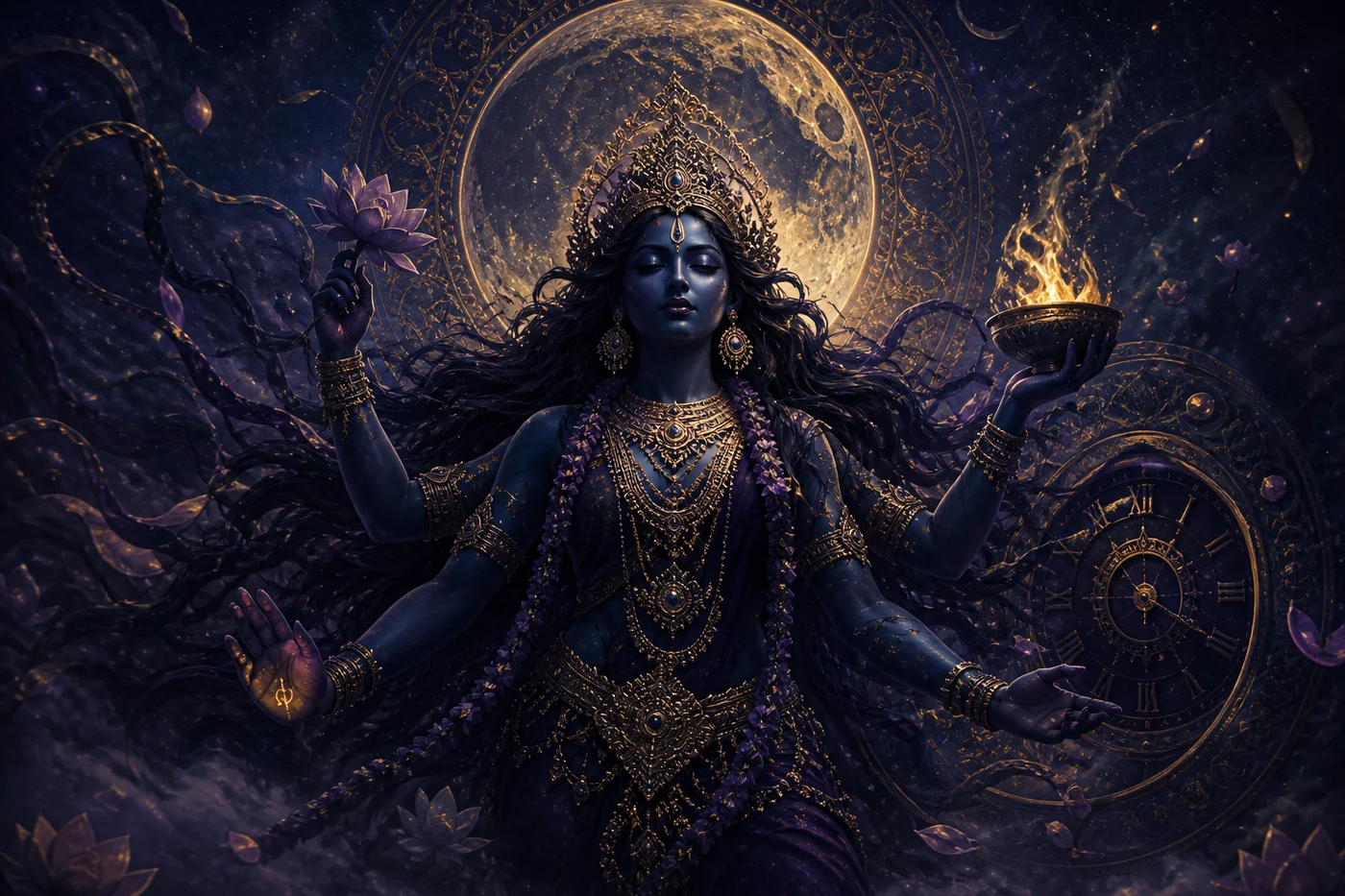
Kali: time, transformation and the power of the sacred feminine
Kali is a powerful figure in Hinduism, often reduced to destruction even though her stories also speak of time, liberation, protection and truth beyond appearances. Understanding her requires respect for the living traditions from which she comes.
Who is Kali?
Kali, also called Kalika, is a major goddess in several Hindu traditions, especially within Shakta devotion and Bengali religious cultures. Her name is associated with kala, time, and kala, dark or black. These linguistic associations do not summarize her theology, but they open a first door: Kali reminds us that every form is born, changes and returns to a wider reality.
Her iconography can look frightening, with a protruding tongue, weapons or a garland of heads. These images are not invitations to violence. They show a power that faces what threatens balance and refuses to disguise mortality.
Protection and liberation
In many devotional contexts, Kali is also the Divine Mother. Her dark appearance is therefore not only about fear: she can be the one who cuts through illusion, protects awareness and accompanies difficult thresholds. This ambiguity matters. The same image may represent the end of a cycle for one person and consolation for another.
Liberation does not mean getting everything we want. It can mean release from control, fear or an identity that has become too narrow. In a contemporary spiritual reading, Kali's symbol can support an honest decision, but it should never replace professional help when a situation requires it.
Stories and limits
Kali appears in several texts and stories, including narratives connected with the Devi Mahatmya, where she is linked with Durga's power and the defeat of forces threatening order. Versions vary across regions, schools and periods. No single story exhausts her meaning.
Ancient sources are also interpreted through living traditions. A modern article should not present a Western or New Age interpretation as the truth of every devotee. Description, comparison and clear limits are more respectful than removing a symbol from context.
Main symbols
Black or deep blue can evoke infinity, mystery and what exceeds form. The red tongue, weapons and cremation-ground imagery recall time's power and the impossibility of holding every form forever. Her relationship with Shiva has many interpretations and should not be reduced to a dramatic image.
These symbols can be contemplated without copying them into a ritual. An image, text or color can support reflection; it does not automatically grant access to a religious practice.
Kali and life transitions
This figure may resonate with grief, a separation, rebuilding, a period of truth or the end of a habit. Spirituality is not about romanticizing pain. It can instead help us acknowledge what is ending and protect what is trying to be born.
Ask: what needs to be named? Which fear still protects an old version of me? Which boundary would make change safer? These questions are more useful than a promise of instant miracles.
An open, respectful practice
Light a simple candle, write what you want to leave behind and distinguish what depends on you from what needs time or support. Close the page, breathe and choose one concrete action. This is a personal writing practice, not a Hindu rite.
Avoid using mantras, gestures, offerings or initiation forms whose context you do not know. Devotional practices belong to communities and specific transmissions.
With the Grimoire
Kali can be connected with the dark Moon, transitions, transformation tarot and emotional journaling. In the Grimoire, record endings, returning fears and decisions that require inner protection. With an active subscription, your chart and transits can help place these periods in context without turning astrology into fixed destiny.
Cultural respect
Kali is worshipped by millions of people. She should not be treated as a gothic character, party aesthetic or quick manifestation tool. The most respectful approach is study, humility, attention to traditions and a clear distinction between Hindu devotion and personal inspiration.