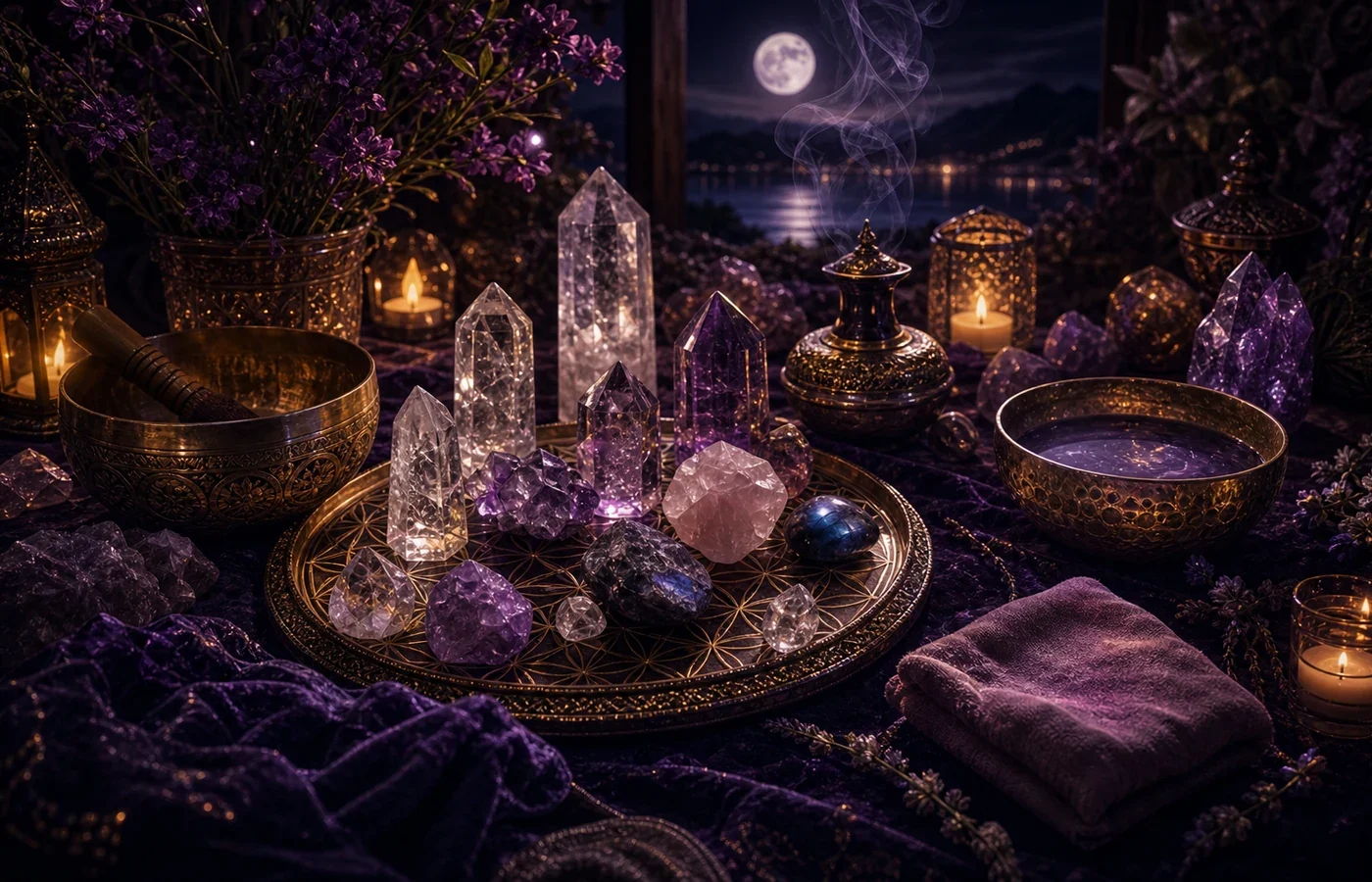
Cleanse and Charge Crystals Safely: Complete Guide by Stone
Cleansing a crystal should never damage it. Many tips recommend salt water, sunlight, or burying, but not all stones tolerate these practices. This guide combines symbolic use with simple geological precautions.
Safety first
If you do not know the exact stone, variety, or treatment, choose dry cleansing. It is the safest method: light fumigation, sound, intention, resting on a clean dish, flower of life, dry quartz cluster, or gentle wiping.
- Avoid soaking porous, soft, organic, or composite stones: turquoise, malachite, lapis lazuli, opal, amber, pearl, selenite.
- Avoid direct salt for almost all stones: it can scratch, dehydrate, enter cracks, and dull surfaces.
- Avoid prolonged sunlight for stones whose color can fade: amethyst, rose quartz, citrine, fluorite, celestite, light aventurine.
- Never mix spiritual cleansing with ingestion: no gem water to drink with malachite, pyrite, lapis, turquoise, or unknown stones.
Gentle methods recommended
For most crystals, dry methods are enough. They protect the material and avoid irreversible mistakes.
- Fumigation: suitable for most stones if the stone does not heat and the room is ventilated.
- Sound: very safe, useful for fragile, porous, or jewelry-mounted stones.
- Indirect moonlight: gentle, especially for stones sensitive to sunlight.
- Dry quartz cluster or flower of life: useful for stones that should not touch water.
- Soft wiping: essential before any ritual.
Methods to use carefully
Water, salt, sun, and earth can have symbolic meaning, but they are also the methods most likely to damage a stone.
- Water: only a short rinse for stable stones; no soaking without certainty.
- Salt: avoid direct contact; if used symbolically, place the stone in a separate container.
- Sun: short exposure only for stable stones; prefer morning light.
- Earth: not recommended for porous stones, fragile polished pieces, jewelry, or collection stones.
Practical table: common crystals
When a method is marked as safe, it assumes a stone that is not dyed, glued, cracked, or mounted in fragile jewelry.
- Amethyst: use smoke, sound, very short rinse; charge with moon or quartz. Avoid prolonged sun and direct salt.
- Rose quartz: smoke, sound, short rinse; charge with gentle moonlight. Avoid strong sun.
- Clear quartz: stable; short rinse possible. Avoid systematic direct salt.
- Citrine: smoke, sound, short rinse. Avoid prolonged sun that may alter color.
- Labradorite: avoid soaking, salt, strong sun, and shocks.
- Lapis lazuli: avoid prolonged water, salt, acids, strong sun.
- Malachite: avoid water, salt, strong sun, elixirs, and chemicals.
- Selenite: absolutely avoid water, salt, humidity, and strong rubbing.
- Pyrite: avoid water, salt, humidity, and damp storage.
- Opal: avoid strong sun, heat, salt, drying, and prolonged soaking.
With the Grimoire
With an active subscription, this guide can help choose a method aligned with your current intention: protection, centering, soothing, clarity, or action. The symbolic choice can adapt to your sign, cycles, and energetic state, while the physical method must always respect the stone.