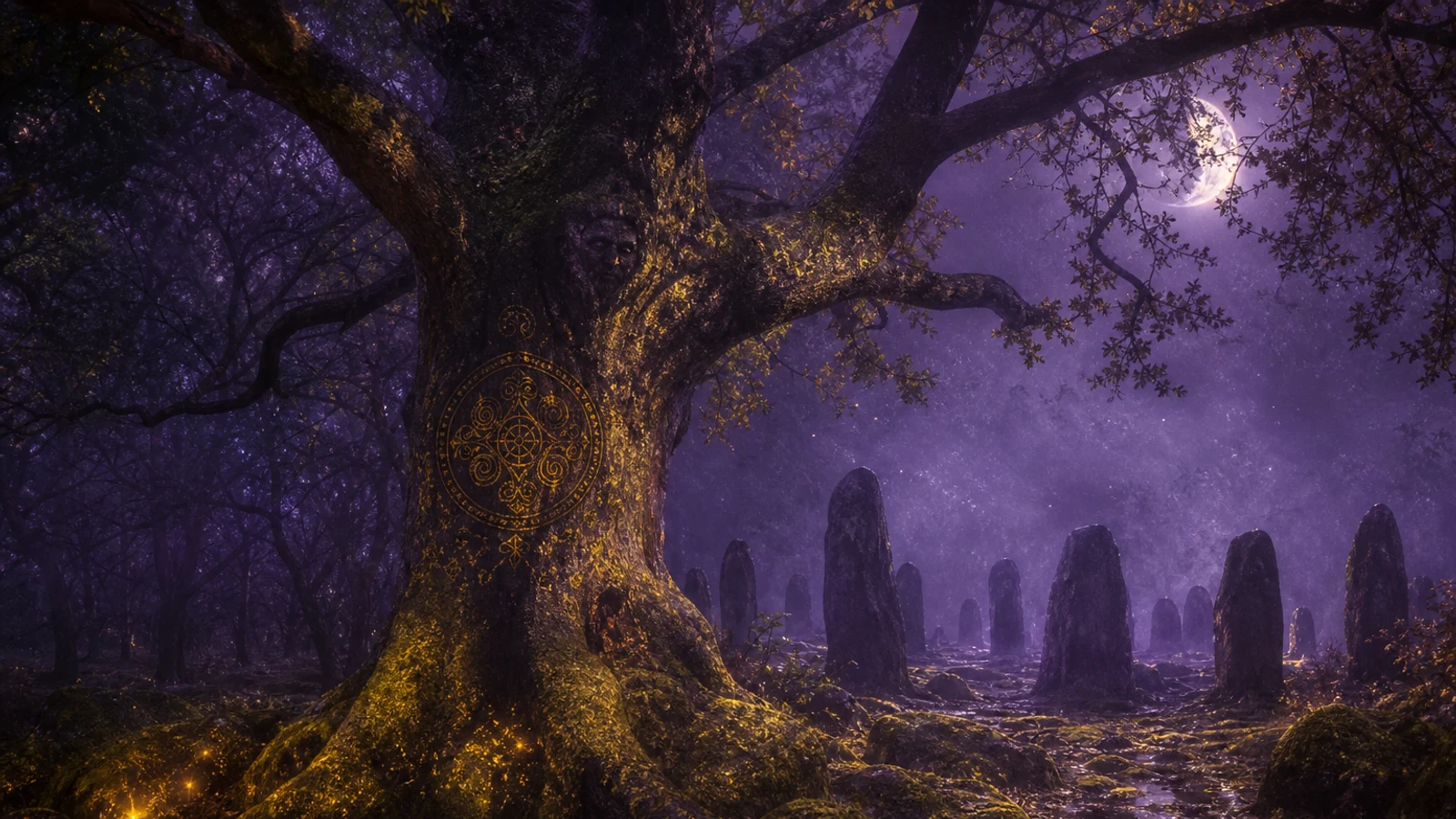
Celtic Spirituality: Nature, Cycles, Sacred Trees, and Intuition
Celtic spirituality is not only misty forests and carved symbols. It carries a worldview where nature is alive, cycles shape the soul, and water, trees, stones, and thresholds become places of dialogue with the unseen. In modern practice, it can help you listen more deeply to seasons, signs, and intuition.
A spirituality rooted in living nature
Celtic imagination places nature at the heart of spiritual experience. The forest is not just scenery: it becomes a teacher. The tree carries memory, the spring purifies, the stone anchors, the wind carries messages, and fire transforms. This path invites less control and more listening.
- Observe cycles instead of forcing an immediate answer.
- Read a place through sensation: silence, density, opening, protection.
- Work with elements as symbolic presences.
- Follow the real season, not only a calendar date.
- Keep practice simple: walking, natural offering, journaling, dreaming.
Celtic cycles as thresholds
Seasonal festivals associated with Celtic traditions are often understood as doors. Samhain speaks of the veil, ancestors, and endings. Imbolc awakens inner light. Beltane celebrates vitality and life force. Lughnasadh honors harvest, effort, and gratitude. These moments can become spiritual markers for reading your own year.
- Samhain: closure, ancestors, dreams, protection.
- Imbolc: gentle cleansing, inspiration, returning flame.
- Beltane: life force, creativity, union of energies.
- Lughnasadh: harvest, courage, transmission, gratitude.
- Solstices and equinoxes: balance, passage, adjustment.
Sacred trees and inner language
In a spiritual reading, trees represent qualities of the soul. Oak evokes strength and axis. Birch speaks of renewal. Yew accompanies symbolic death and rebirth. Hazel is linked with intuitive wisdom. Willow opens emotions and lunar listening. These correspondences are not rigid rules; they are a living language.
- Oak: stability, sovereignty, protection.
- Birch: new beginning, cleansing, new skin.
- Yew: passage, grief, deep transformation.
- Hazel: intuition, inspiration, search for meaning.
- Willow: emotions, dreams, lunar sensitivity.
Springs, stones, and threshold places
Ancient springs, megaliths, clearings, and ridge paths hold a strong place in European magical imagination. They are places where people come to place, ask, thank, or simply listen. The most respectful gesture is often discreet: take nothing, damage nothing, and leave the place cleaner than you found it.
- A spring can support a ritual of clarification.
- A remarkable tree can become a meditative anchor.
- A standing stone can symbolize axis and memory.
- A clearing can mark a threshold between noise and silence.
- An offering can be breath, prayer, or cleaning the place.
Druids, bards, and ovates: memory with nuance
The ancient Celtic world did not leave a complete spiritual manual written from inside the tradition. Part of what we know comes from archaeology, medieval Irish and Welsh literature, and outside Greco-Roman authors. Druids are often described as priests, judges, scholars, counselors, or keepers of memory; bards transmit through poetic speech; ovates are associated with inspiration, divination, and the living world. Spiritually, this invites us not to freeze these roles into modern costumes, but to understand three inner functions: knowing, singing, sensing.
- Inner druid: seek knowledge, balance, and right speech.
- Inner bard: transmit, name, tell, give form to experience.
- Inner ovate: listen to signs, dreams, plants, and cycles.
- Do not pretend to perfectly reconstruct what has been lost.
- Prefer humble, documented, personal practice.
Nemeton: sacred space in nature
Celtic-inspired practice is often associated with natural sanctuaries, sacred groves, or spaces set apart from ordinary life. The word nemeton evokes a consecrated place where one enters differently. Today, a personal nemeton can be a clearing, a tree, a stone, a garden corner, a spring, or even a sober seasonal altar. What matters is not staging, but a change of presence: enter, become quiet, listen, give thanks.
- Mark the symbolic entrance to the place.
- Leave nothing that pollutes or damages.
- Use non-intrusive offerings: silence, water, song, cleaning.
- Return to the same place to build relationship.
- Record seasonal changes in scent, light, and emotion.
Animals, omens, and sovereignty
Celtic stories give strong importance to animals: raven, stag, boar, salmon, horse, swan, dog, or serpent depending on region and tradition. These figures are not decorative; they speak of instinct, territory, courage, wisdom, passage, or sovereignty. The raven can recall lucid shadow work, the stag inner nobility, the salmon deep knowledge, the boar a force that breaks through obstacles. In modern practice, animals should not be forced into automatic totems: repetition, context, and emotion create meaning.
Celtic intuition: listen before interpreting
This path suits people who strongly feel places, seasons, and natural signs. A feather, a crow, sudden mist, a dream of a tree, or a sensation near a spring can become meaningful when you take time to record it. The key is not to turn everything into an omen, but to notice repetition and emotional quality.
Practicing today without empty folklore
Modern Celtic-inspired practice becomes stronger when it stays simple and respectful. Instead of collecting symbols, build a regular relationship with a place, a season, a tree, a flame, or a journal. Power comes from conscious repetition: return, listen, thank, write, adjust.
- Create a simple seasonal ritual.
- Keep a notebook of natural signs.
- Choose one tree-guide for a month.
- Take a phone-free walk in a living place.
- Link an intention to a lunar phase.
A simple Celtic-inspired seasonal ritual
Choose a season and one dominant element. In autumn, work on closure with a fallen leaf and a candle. In winter, work on watchfulness with a dark stone and a protection sentence. In spring, work on renewal with clear water and a seed. In summer, work on vitality with a flame or a solar flower. This ritual does not need to be spectacular: it should be repeated, sincere, and linked to the real landscape around you.
- Name the cycle: what begins, ripens, declines, or ends.
- Choose a natural element without tearing needlessly.
- Write one short sentence in your journal.
- Make a gesture of gratitude.
- Return one month later to observe what changed.
With the Grimoire
In the Grimoire, you can connect this approach with lunar phases, emotional journaling, dreams, and current transits. With an active subscription, the article becomes more personal: the tool helps reveal whether your period supports grounding, cleansing, intuition, closure, or opening. Celtic practice then becomes a living cycle adapted to your chart, not a generic recipe.