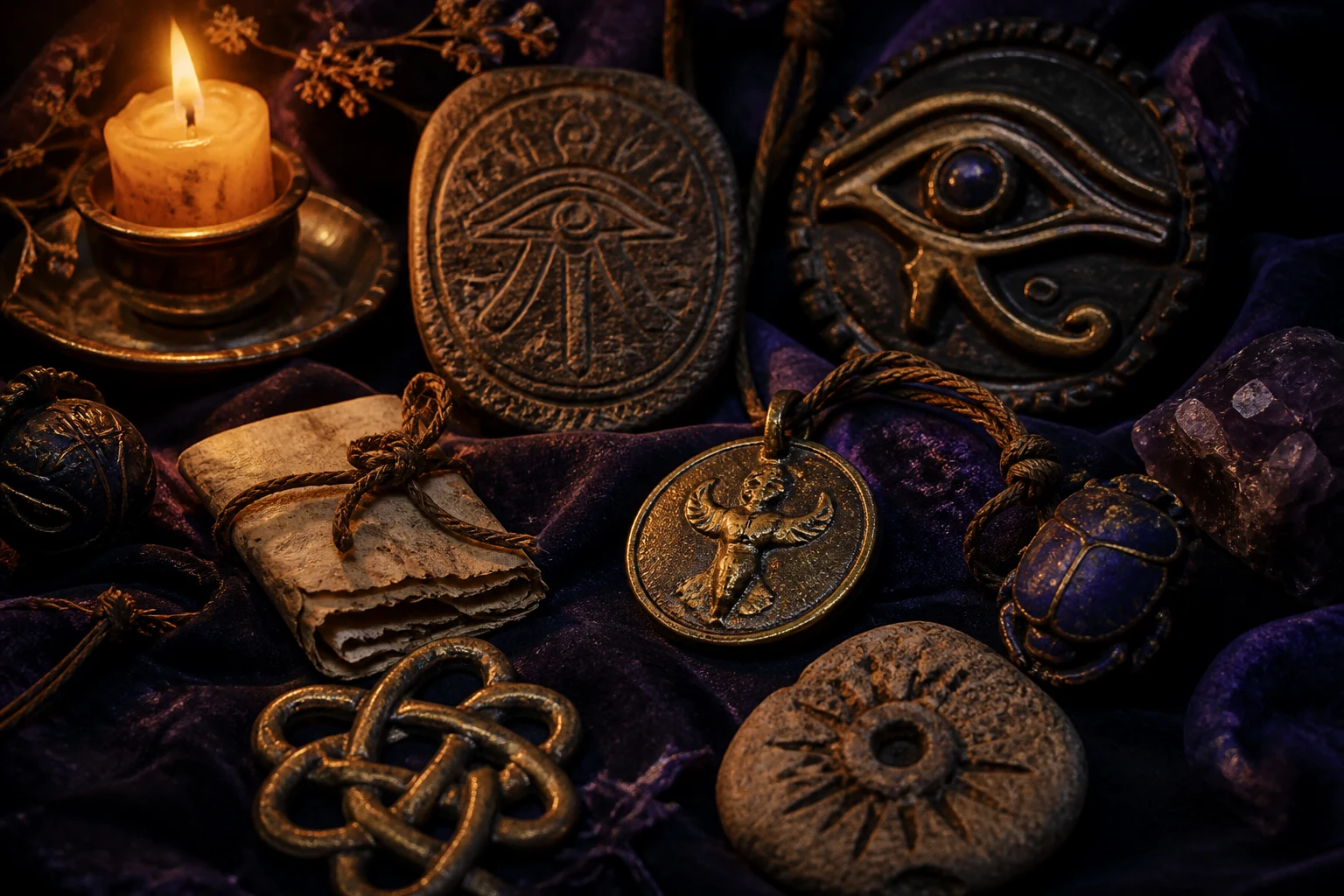
Amulettes et talismans antiques : protection, symboles et intentions
Une amulette se porte ou se conserve pour accompagner une personne, tandis qu'un talisman est souvent pensé comme un objet préparé pour une intention particulière. Les frontières historiques sont souples, mais tous deux racontent une même envie : donner une forme visible à une protection, une prière ou un engagement.
Amulette et talisman : deux mots proches
Dans l'usage courant, amulette et talisman sont souvent employés comme des synonymes. Les historiens des religions et de la magie les distinguent parfois : l'amulette protège par sa présence et son port, tandis que le talisman est davantage associé à une fabrication intentionnelle, à une inscription, à une image ou à un moment astrologique.
Cette différence n'est pas absolue. Les objets anciens ne portent pas toujours leur mode d'emploi et les catégories modernes ont été construites après coup. Il vaut mieux parler de fonctions et de contextes que de chercher une définition universelle.
Des objets entre religion, magie et quotidien
Les amulettes ne vivaient pas forcément à l'écart de la religion officielle. Elles pouvaient accompagner une prière, être déposées dans une maison, placées près d'une tombe ou portées par une personne malade, voyageuse ou enceinte. Le geste protecteur appartenait à la vie quotidienne autant qu'aux spécialistes.
Une amulette raconte donc une relation : à une divinité, à un ancêtre, à un lieu, à une peur ou à un espoir. Sa valeur ne se résume pas au matériau. Elle dépend de l'histoire confiée à l'objet et du lien qu'il maintient avec la personne.
Les grands symboles protecteurs
Œil, nœud, cercle, serpent, scarabée, lune, soleil, main, clé, cœur, arbre et pierre apparaissent dans de nombreuses traditions. Leur sens varie selon l'époque et la culture. Un œil peut évoquer la vigilance, une clé l'accès, un nœud la continuité, un cercle la totalité et une graine la promesse de renouvellement.
Il faut éviter de transformer tous ces signes en dictionnaire automatique. Le même motif peut protéger, avertir, accompagner un passage ou rappeler une divinité précise. Une lecture honnête indique l'origine du symbole et laisse une place à l'interprétation personnelle.
Matières et mémoire
Pierre, métal, bois, cire, tissu, papier, verre et perle ont été utilisés dans des objets protecteurs. La matière donne une texture à l'intention : la pierre évoque la durée, le métal la résistance, le bois le vivant, le tissu le proche et le papier la parole écrite.
Une matière n'est pas « chargée » de manière universelle. Elle peut devenir importante parce qu'elle vient d'un lieu, d'une personne, d'un moment ou d'un souvenir. La relation est souvent plus riche que la promesse d'une propriété magique fixe.
Talismans et temps astrologique
Certaines traditions talismaniques associent l'objet à un jour, une heure, une planète ou une configuration céleste. Cette logique repose sur des correspondances entre le ciel, la matière et l'intention. Elle peut être étudiée avec la page Planètes du Grimoire, mais elle ne doit pas être confondue avec une garantie de résultat.
Une lecture contemporaine peut utiliser le temps astrologique comme un cadre de concentration : choisir un moment, écrire une intention, agir avec cohérence et noter ce qui évolue. L'objet rappelle l'engagement ; il ne remplace pas l'action.
Protection, ancrage et passage
Les objets protecteurs sont souvent associés aux seuils : naissance, voyage, mariage, maladie, deuil, changement de maison ou passage professionnel. Ils servent à marquer une période où l'identité se transforme et où l'on cherche un repère.
Un talisman peut alors représenter une limite saine : ce que j'accueille, ce que je refuse, ce que je protège et ce que je laisse partir. Cette approche est particulièrement utile lorsque la protection n'a pas besoin d'être dramatisée.
Créer un objet symbolique moderne
Choisissez un petit objet neutre que vous pouvez garder sans gêner personne. Nettoyez-le simplement, écrivez une intention courte et réaliste, puis associez-lui une action. Pour la protection, l'action peut être poser une limite, ranger un espace, demander de l'aide, dormir suffisamment ou quitter une situation dangereuse.
Gardez l'objet quelques jours, observez vos réactions et relisez votre phrase. Si l'objet ne vous parle plus, vous pouvez le ranger ou le recycler. Aucun talisman ne doit devenir une obligation, une source de peur ou un substitut à une décision nécessaire.
Ce qu'il vaut mieux éviter
Ne promettez pas une guérison, une richesse certaine ou une influence sur une personne. N'utilisez pas de symbole religieux fermé sans en comprendre le contexte. Ne prenez pas une pièce archéologique, ne dégradez pas un lieu ancien et ne présentez pas un objet moderne comme une antiquité authentique.
Si vous achetez une pierre, un métal ou une plante, vérifiez sa provenance et ses précautions. La spiritualité commence aussi dans la manière de consommer, de respecter les cultures et de ne pas transformer la vulnérabilité en argument commercial.
Avec le Grimoire
Le Journal peut garder la date de création, l'intention, le symbole choisi et les changements observés. La Lune et les Planètes peuvent donner un rythme de réflexion ; les Rituels aident à préparer un geste simple ; les Pierres offrent un vocabulaire de matière et de couleur.
Avec un abonnement actif, vous pouvez relier l'objet à vos cycles émotionnels et à votre thème natal, sans en faire un verdict. Le talisman devient alors un rappel personnalisé plutôt qu'une promesse extérieure.
Pour conclure
Une amulette ne vaut pas seulement par ce qu'elle est censée faire. Elle vaut aussi par ce qu'elle aide à se rappeler. Protection, mémoire, passage et engagement peuvent tenir dans un objet simple, à condition de garder les pieds dans le réel et le cœur ouvert au symbole.