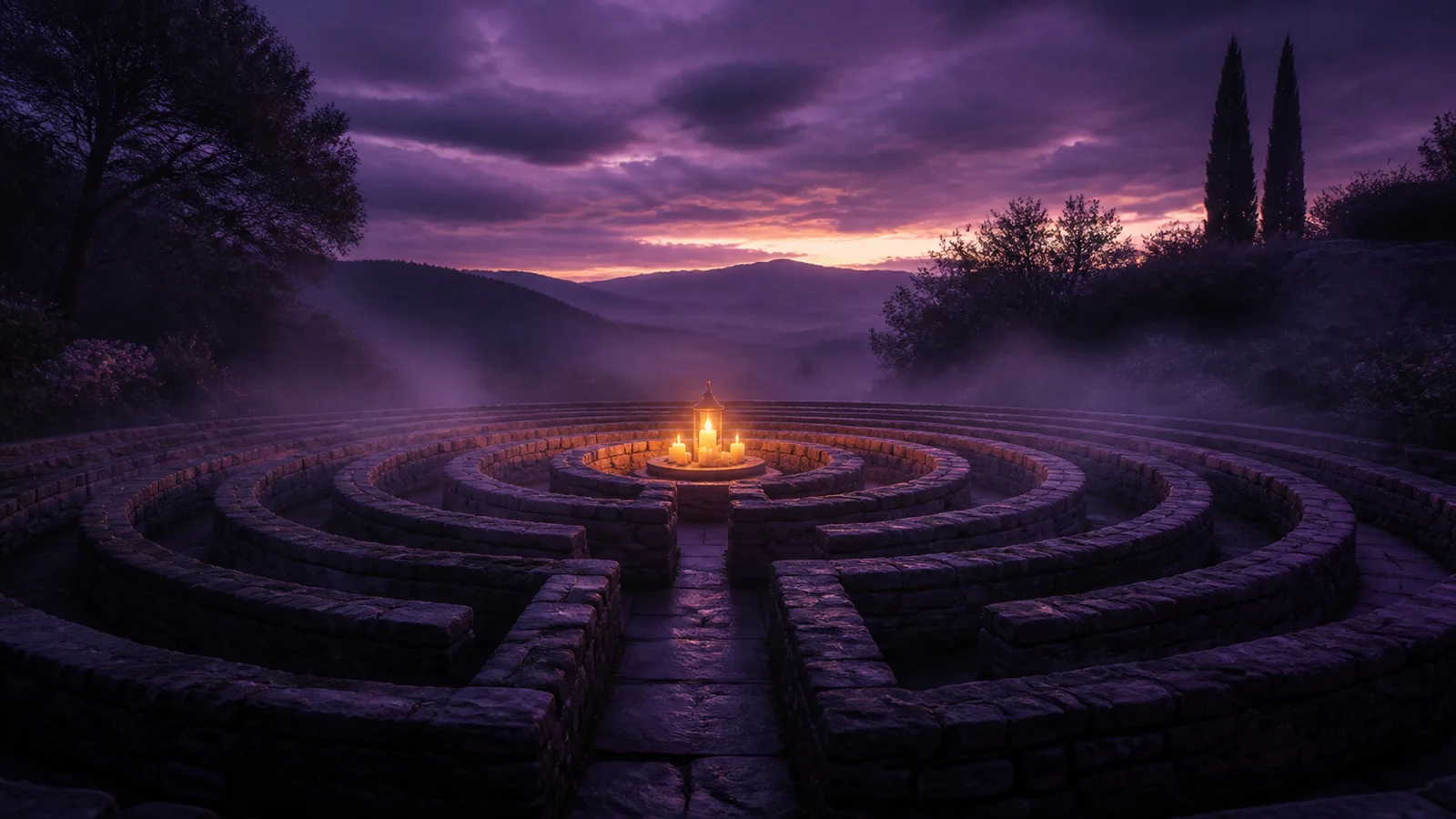
The spiritual labyrinth: walking to find your inner path
A labyrinth does not ask you to rush toward an exit. It invites you to walk, turn back, slow down and accept that an inner path is not always straight.
An ancient symbol of the inner path
The spiritual labyrinth represents a journey with a direction whose destination is not immediately visible. Unlike a maze designed to make people lost, it usually offers one path that leads to a centre before bringing the walker back outside. The experience is not about defeating a trap, but meeting your own detours.
Symbolically, the centre may represent an intimate truth, a decision, prayer or space of silence. The return reminds us that an insight matters when it can be carried back into daily life.
Why walking can bring clarity
Repetitive walking often calms the part of the mind that wants to solve everything at once. The rhythm of the steps gives the body a structure while thoughts move. The labyrinth offers enough slowness to distinguish calm intuition from emotional urgency.
Enter with a clear intention
Choose one short sentence: “What do I need to understand about this transition?”, “What deserves my energy?” or “Which boundary do I need to set?”. Then let the question rest. Intention opens the path; it should not become constant monitoring.
Moving toward the centre
The path may move away and then return close to the centre. This can echo periods when we think we have gone backwards while a deeper understanding is forming. At the centre, stand still and notice your breath, body and the word that returns. A simple sentence or one action may be enough.
A home ritual
Draw a winding path on paper. Place an unlit candle beside it and write your question. Trace the path with your finger while breathing slowly. At each turn, name what you are willing to leave behind: urgency, fear, comparison or guilt. At the centre, write one resource you already have. On the way out, write one action you can take within twenty-four hours.
With the Grimoire
In the Grimoire, record your intention, lunar phase, emotional state and the word that appeared at the centre. With an active subscription, these observations can be read alongside personal cycles, transits and rituals to follow how the same question changes over time.