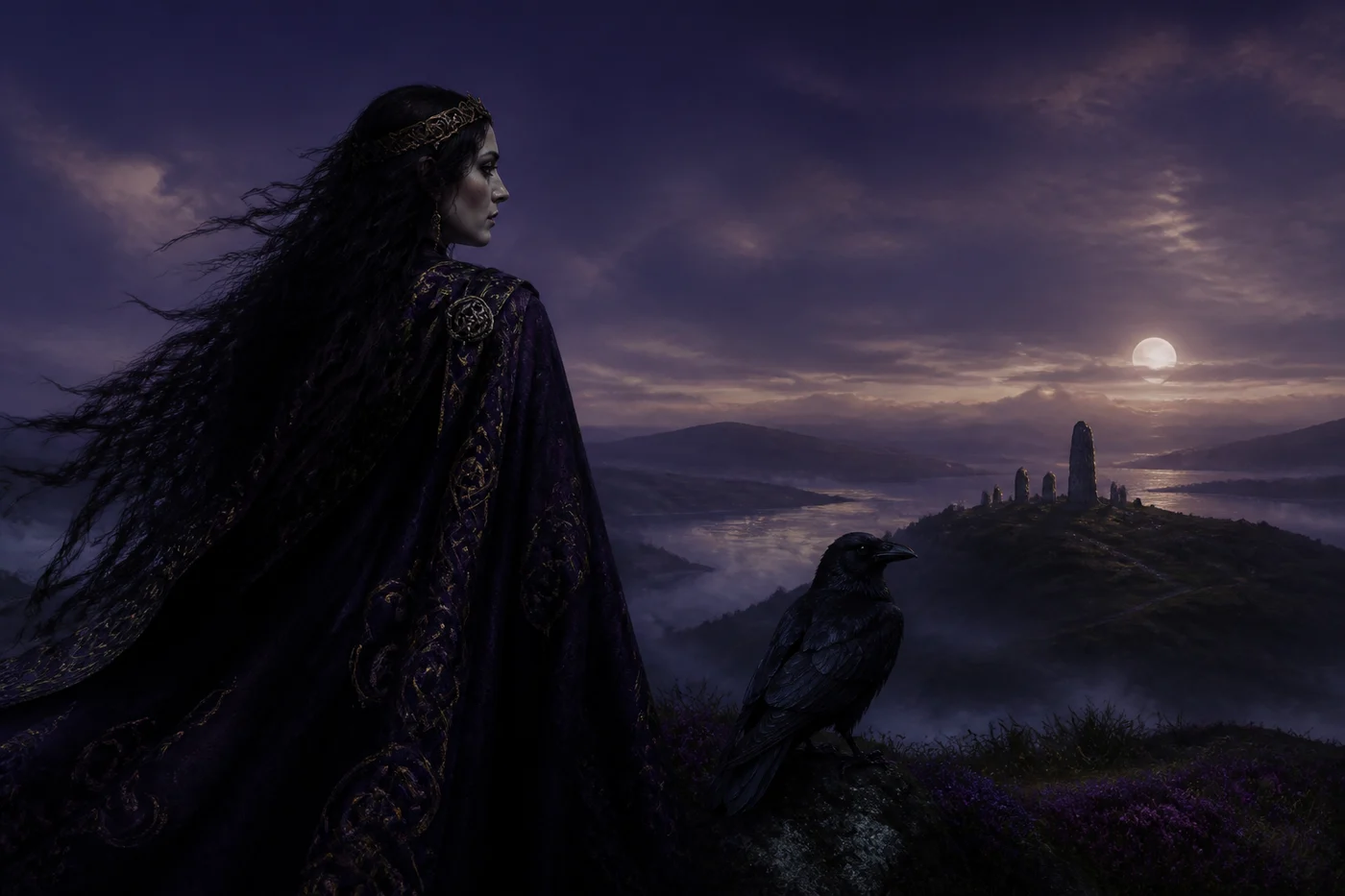
The Morrígan: sovereignty, fate and transformation in Irish mythology
The Morrígan is a complex figure in Irish mythology, associated with sovereignty, fate, battle and transformation. The texts do not present a modern goddess with perfectly fixed attributes: her appearances are multiple and sometimes contradictory.
A figure that resists simple labels
The Morrígan, Mórrígan or Morrigu appears in several medieval Irish narratives. Her name and relationships vary across manuscripts and interpretations. She may be presented as one figure, a group of figures or a power connected with land and sovereignty.
This instability is part of the subject. It warns us not to give her a perfectly fixed profile, as if an oral and literary tradition could be reduced to a modern questionnaire.
Sovereignty and land
In many readings of Irish mythology, sovereignty is more than political power. It can describe the relationship between people, land, responsibility and the ability to govern fairly. The Morrígan becomes a threshold figure: she questions the legitimacy of those who seek power.
For personal reflection, the question is not “how do I become powerful?” but “how can I use power without betraying my values, body or the people involved?”
Battle, fate and warning
The Morrígan is associated with battle and death in several stories. It would be reductive to turn her into only a war goddess. She may announce, provoke, comment on or accompany a turning point; her role often resembles a power that reveals what heroes would rather avoid seeing.
In contemporary practice, this theme can help observe conflict, power dynamics and irreversible decisions. It never justifies violence, manipulation or the pursuit of fear.
Ravens and transformation
Ravens and battle birds are connected with her imagery in many interpretations. Transformation shows an identity capable of changing viewpoint and moving through different forms. It does not mean every raven is a supernatural message.
A sign becomes more useful when observed with repetition, context and discernment. A symbol can open a question; it should not decide for you.
Cú Chulainn and the hero
Stories involving Cú Chulainn are often used to discuss the Morrígan. Versions differ, and modern readings should not erase the complexity of desire, refusal, power and fate. It is safer to describe a tense narrative relationship than a simple romance.
This story can support reflection on boundaries: intuition never authorizes forcing a relationship, and a refusal is not an invitation to insist.
The triad and multiple names
Texts sometimes connect the Morrígan with Badb, Macha and other figures. Scholars do not always agree on how to understand these connections. The respectful approach is to present the debate rather than claim an absolute equivalence.
Multiple names remind us that mythologies do not always work like modern pantheons, with one fixed function and color per deity.
A practice of inner sovereignty
Write about one situation where you abandoned your voice, then one where you used power fairly. Add one concrete boundary and one repairing action. You may place a raven drawing as a personal symbol without presenting it as an Irish ritual object.
This practice works with discernment and responsibility. It does not claim to invoke a deity or reconstruct an ancient ceremony.
With the Grimoire
The Morrígan can be connected with Mars and Pluto transits, decision periods, difficult-choice tarot and boundary journaling. With an active subscription, use your chart to observe where you seek renewed sovereignty without treating a transit as an obligation.
The Spiritual Map can also support reflection on Irish hills, springs, forests or legendary places while respecting access, communities and each site's history.
Respecting the tradition
Irish mythology comes through late, fragmentary literary sources, often copied in a Christian context. Avoid definitive claims, using Gaelic terms without understanding them and turning the Morrígan into a mascot for dark magic.
Study, source reading and respect for Irish culture offer a richer relationship than borrowing an aesthetic.