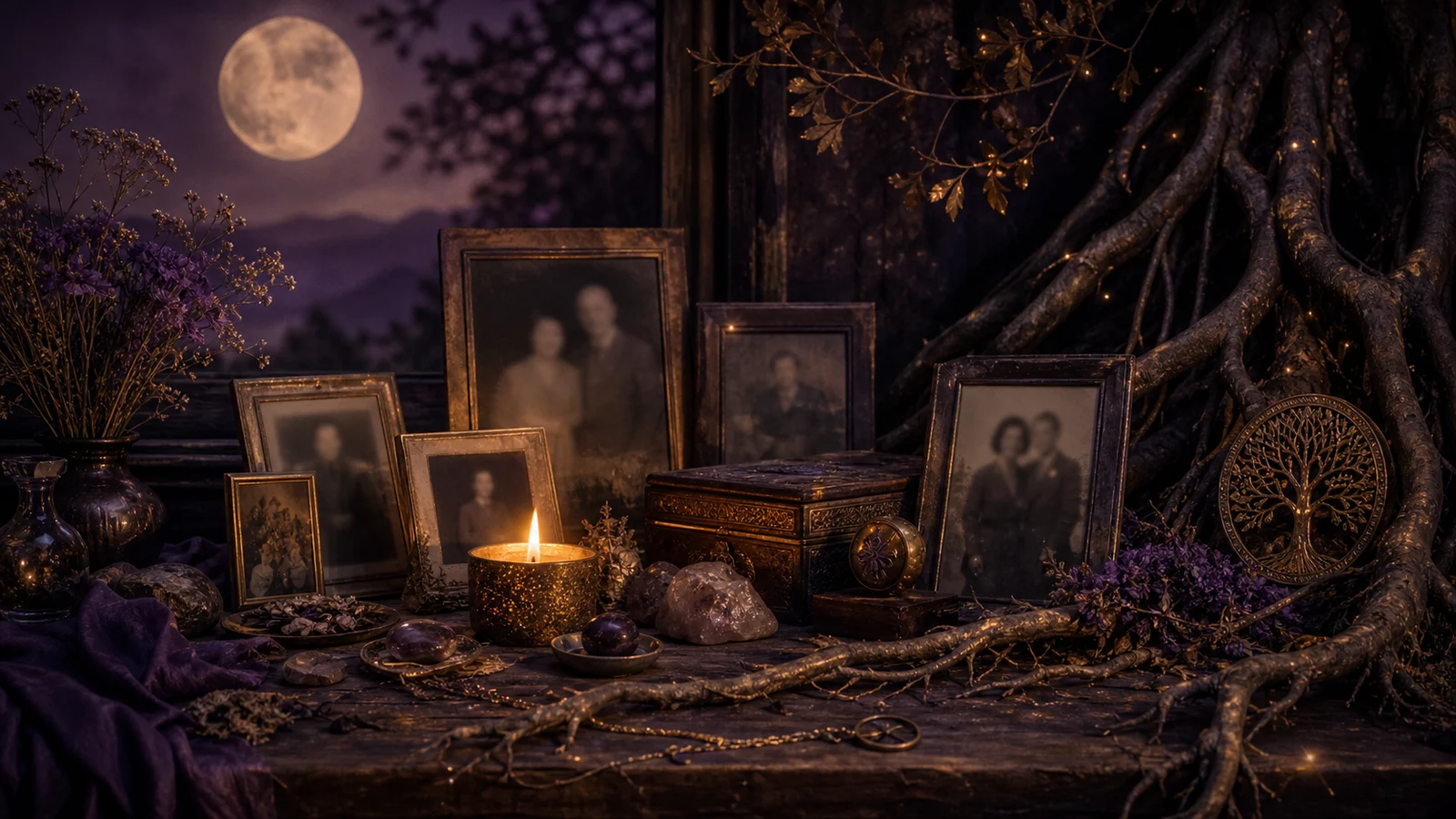
Ancestors and spirituality: honoring without idealizing
Working with ancestors can be very powerful, but it requires one essential nuance: honoring does not mean idealizing. A lineage may carry strengths, protections, gifts and memories, but also silences, wounds and patterns to transform.
Why ancestors matter
Ancestors represent a chain. They are not only deceased people, but also gestures, lands, languages, choices, fears, courage and transmissions. Even when we do not know our family history, we sometimes carry impulses or tensions that feel larger than ourselves.
Ancestral spirituality gives language to this depth.
Honoring does not mean accepting everything
A common mistake is believing that honoring ancestors requires excusing the past. It does not. You can honor transmitted life without validating violence, silence or destructive patterns.
A simple sentence can help: "I receive the strength, I return the suffering, I transform what must be transformed."
Protective ancestors
Not all lineages feel the same. Some ancestors may be experienced as protective, others as blurry, heavy or absent. You do not have to open your practice to the whole lineage.
You can ask to be connected only to benevolent presences, memories of strength and protections that respect your balance.
Creating an ancestral space
An ancestral space can be very simple: candle, glass of water, photograph, inherited object, flower, written name, family recipe, song. If you have nothing, a paper with the phrase "my protective ancestors" is enough.
The goal is not beauty. The goal is opening a clear and safe space.
Ancestral dreams
Ancestors often pass through dreams: family house, deceased person, meal, keys, suitcase, tree, child, old road. An ancestral dream sometimes leaves a particular feeling, as if a memory had been touched.
Write the dream without concluding too quickly. Ask: what seeks recognition? what wants repair? what wants to be returned?
Breaking a pattern without breaking the lineage
Transforming family memory does not mean rejecting everyone. You can love a lineage and refuse a pattern. You can thank an inheritance and set a boundary. You can keep the strength and cut the repetition.
This is often where ancestral work becomes spiritually powerful: it turns love into lucidity.
Simple memory ritual
Light a candle. Place a glass of water. Say: "I honor the ancestors who support my life, clarity and protection." Then write three columns: what I receive, what I return, what I choose to transform.
After the ritual, change the water and return to the present with a concrete gesture: tidying, walking, eating, breathing.
When to be careful
If your family history contains trauma, violence or intense fear, move slowly. Ancestral work can awaken strong emotions. It does not replace therapeutic support when needed.
You can keep a very light symbolic practice: a gratitude candle, a boundary sentence, no direct calling.
Ancestors, places and objects
Some family objects carry memory. Some places awaken a lineage feeling. A house, land, village, photograph or recipe can become a doorway. But a doorway must be able to close.
Do not keep an object because you "must". Keep what supports. Release what weighs.
Link with the Grimoire
In the Grimoire, you can connect ancestral work with dreams, journaling, rituals, lunar periods and emotional tracking. With an active subscription, observe whether family themes return around transits, full moons or fatigue periods. Repetition becomes readable, therefore transformable.